Crocodile Clan Male Initiation Ceremony & Sepik River Expedition
During this 12-day trip, you will and may be able to:
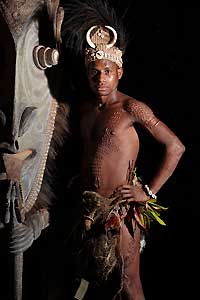
- Travel by canoe to the Upper Sepik and Middle Sepik to visit villages with ancient beliefs and rituals. We will meet the famed crocodile men, known for their intricate crocodile-skin scarification marks, and we will be allowed to observe an initiation ceremony.
- Visit many varied Spirit Houses and discover the Iatmul tribe & mythologies of wayward spirits and how an animalistic culture still hold sway over traditional village lifestyles.
- Journey along the Sepik River, we will have many bird-watching opportunities (with good chances to see several birds of paradise).
- Visit numerous villages for artefact buying opportunities and may be allowed to go out with the crocodile men to observe their traditional livelihood of hunting crocodiles at night. - Visit many (varied) villages along the Sepik River that offer opportunities to purchase crafts and artefacts, including spectacular masks, stone tools, shields figures and axes!
ITINERARY:
Day 1: Port Moresby - Wewak (D)
Fly from Port Moresby (departing approx. at 10.00 am) to the town of Wewak where you will bemet at the airport and transferred to the “In-Wewak Boutique Hotel” for your overnight stay. A group dinner will be arranged where a detailed briefing meeting will be included.
Day 2: Wewak - Pagwi - Wagu Laggon (B, L, D)
After breakfast, at 8:30 am, we drive to the small town of Pagwi on the Sepik River (about 5 hours driving time). We break the journey on route for a cold drink and sandwiches break. At Pagwi, we meet with our canoes and canoe men who will transport you up river to visit Wagu Lagoon in the Upper Sepik and check into the guest house there. Overnight and dinner in the guesthouse.
Days 3 and 4: Travel to Yambon/Yassan/Maio villages (B, L, D)
Awake early and visit birds of paradise sites to (hopefully) see Raggiana birds of paradise performing their dawn chorus. Sightings cannot be guaranteed, but we have a good chance! After birding, we return to the guesthouse for breakfast. We then continue up river to visit Yambon village to visit the Haus Tambaran (Spirit House). We continue further up river to the villages of Yessan and Maio, which follow a Yam culture (as can be seen in their carved artefacts). We dine and sleep in village family houses in the Upper Sepik for the nights of days 3 and 4.
Day 5: Travel to Tongujam-Ambunti (B, L, D)
Today we journey by canoe to Tongujam to visit the distinctive (and very different) Spirit House of that village. Afterwards, we begin the return journey down river stopping off at a few other villages and overnight and dine in a family house near Ambunti.
Day 6: Travel to Korogo/Yumuk villages (B, L, D)
Today we canoe down river to Korogo Village fishing lake. There we start a 2-hour trek inland through the tropical rainforest into the delightful village of Yumuk. We visit some of the 6 Spirit Houses within Yumuk which are beautifully and distinctly decorated with painted beams and rafters from natural clay colours of ochre, grey, white and black sourced from the Sepik River. This style is unique to Yumuk. We dine and sleep in the Yumuk village guesthouse.
Day 7: Travel to Middle Sepik - Kanganamun village (B, L, D)
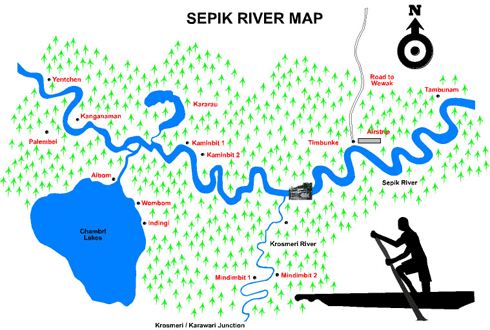
After visiting any remaining Spirit Houses, which we did not see yesterday, we trek back to the canoes at the fishing lake and travel further down river to the Middle Sepik region, which is the Iatmul tribe’s area. The Iatmul are famed for their ‘Crocodile Clan Culture’ and occur across this part of the Sepik River. We visit Kanganamun village, which has the largest Spirit House on the entire river. We dine and sleep in Kanganamun village guest house. An opportunity to go with the villagers crocodile hunting (their traditional livelihood) may be possible in the evening.
Day 8: Travel to Palembei village (B, L, D)
After breakfast, we visit Palembei village (also the Iatmul tribe). The village is home to two spectacular Spirit Houses filled with artefacts, some of which are for sale. Late in the afternoon, we travel to the initiation ceremony location, and make a base camp in the village guest house and/or family houses nearby.
From early evening the already initiated men will start their traditional chanting, and marching round and round, each calling out to their own ancestral Crocodile Spirits for support and guidance for the following morning’s ritual. We have the option to stay with them all night listening to the mysterious, hypnotic chanting (though there will be accommodation should anyone wish to sleep).
Day 9: Travel to Kimindibit village & Chambri Lakes (B, L, D)
At the first light of dawn, we arise and gather outside the Spirit House where the initiation ritual will commence. The, to be initiated, young men are taken in behind the leaf fence into the Spirit House. In an age-old tradition, the Iatmul tribe cuts the skin of their young men to initiate them. The skin cuts cause scars in patterns that resemble the scales of a crocodile. We may be allowed to witness this ancient custom from start right through to completion inside the Spirit House. The highest respect is required from all visitors during this very private and intimate ritual. After lunch, we travel by canoe to visit the village of Kimindibit where the village ladies will demonstrate daily village tasks of grass skirt making, weaving, sago making/cooking. We then travel onto Aibon (a clay pottery centre) and visit the Chambri Lakes. We dine and sleep in a local guest house.
Day 10: Travel to Kanganamun village (b, L, D)
Today, we visit a series of villages of the Chambri Lakes, then travel back up river to Kanganamun village. We dine and sleep in Kanganamun village guest house. We may have a second opportunity to observe the villagers crocodile hunting (their traditional livelihood).
Day 11: Travel to Korogo village - Pagwi - Wewak (B, L, D)
After breakfast the next morning, we motor upriver, stopping off at Korogo village before we return to Pagwi. We say goodbye to the boatmen, transfer into a private charter bus, and are driven back to the “In-Wewak Boutique Hotel” where we will have a group dinner and overnight. We will hopefully aim to arrive in Wewak during the early afternoon so if you wish to walk around the town market that would be possible.
Day 12: Wewak - Port Moresby (B)
After breakfast, we transfer from the hotel to Wewak airport for a flight to Port Moresby. We should land at Port Moresby airport by 5 pm (possibly earlier) in time for 7:30 pm departing flights. Depending upon the schedule of flights, we may be able to arrive back at Port Moresby early enough to visit one or more art and artefact traders, and a shipping agent (to send back any items as required).
WE ARE OFFERING AN ALL-INCLUSIVE COST OF USD $4,800 per person for this expedition. This includes economy airfares from Port Moresby to Wewak return. Standard accommodation with meals for two nights in the “In Wewak Boutique Hotel”. All transport costs, all food and accommodation on the river, an English speaking local initiated guide, bedding and mosquito nets, private chartered bus with AC from Wewak to Pagwi return and airport transfers.
EXCLUDING: International flights and accommodation/transfers in Port Moresby prior the start of the trip.
NOTE: this trip includes an essential 25,000 Kina (approx US $7,580) donation from our group to the Iatmul community as a gesture of friendship to help the lives of old and young people. This cost is paid out of your fee and not additional. This is essential to enable our access to these fascinating villages and witness the Iatmul way of life and the initiation ceremony.
DEPOSIT POLICY: US $1,920 to reserve your place (non-refundable, unless we can find a replacement to step into your booking). The balance is due 8 weeks prior to departure.
START POINT: Port Moresby, Papua New Guinea.
END POINT: Port Moresby, Papua New Guinea.
NOTES:
- All journeys to the Sepik River depend upon the level of the water during the time of the visit. The water level may impact the speed at which we can travel and which villages we can visit. While it is our intent to visit all of the villages listed above, participants on this expedition must understand that changes to the itinerary may arise. If any changes to the plan are necessary, all adjustments will be discussed openly with the group.
- On the Sepik River the accommodation is basic, and you will be staying in guesthouses or village family houses. There are only basic washing and toilet facilities available. In Wewak at the “In Wewak Boutique Hotel” will be based on twin/double share, single supplement will incur a surcharge.
- Group size: max. 10 pax, plus staff
- NEXT AVAILABLE DATE: 24th June - 05 July 2019

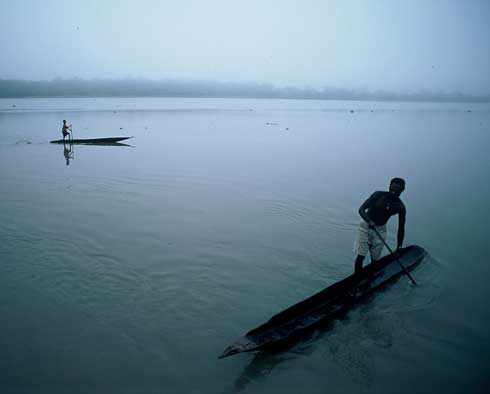
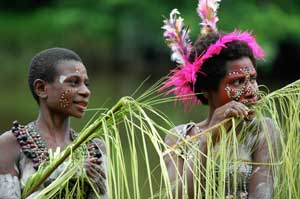 The Sepik River is one of two vast tropical rivers in Papua New Guinea, that meander through the densely forested lowlands of the world's second largest… and the world's tallest… island. Along the banks of the river and its many tributaries live sparsely scattered, remote villages, scarcely contacted by the outside world, where people live a lifestyle that has changed little for thousands of years.
 Revering the crocodiles that inhabit the rivers, the people of the Sepik have traditions and customs that can be found nowhere else, building large and elaborate spirit houses (has tamboran) in their villages to house the good spirits - and at times the menfolk of the village - and producing intricate wood carvings to ward off the evil spirits. The staple foodstuffs are fish and sago flour, extracted from the pith of the sago palm.
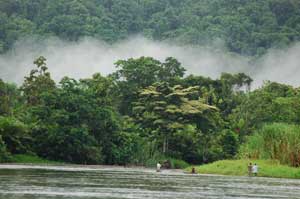 During your adventure, you will have the chance to visit and encounter the village people of the Sepik Basin, explore river systems that drain some of the densest and most inaccessible rainforests in the world, look out for Birds of Paradise and many other bird species, and collect some of the exquisite wood carvings that Sepik villages are renowned for.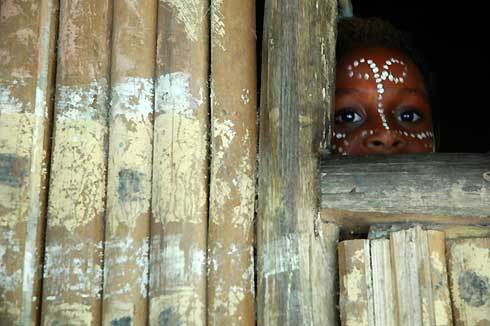
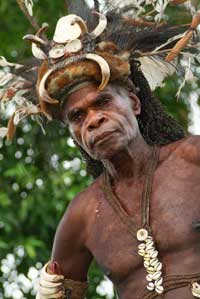 The people of the ecologically diverse Sepik region speak more than 250 languages and are knitted together in systems of trade and cultural interaction. Ritual, genealogical and historical knowledge defines one group from another and maintains the distinctions that facilitate trade.
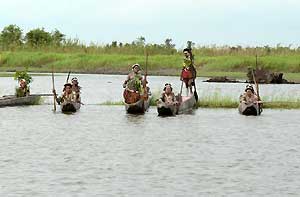 Head hunting was a river culture practice in the Sepik area. The fact that young men could only come of age in these regions by taking a head, suggests how incessant warfare must have been. The Iatmul people of the Sepik would take the heads in battle, boil away the flesh and hang the painted and decorated skulls as trophies in the men's houses. The head hunters were not necessarily cannibals,
  but many were. Human flesh was eaten until fairly recently and some of the older men from villages remember tasting it as children, they will tell you that it tasted a little bit like chicken.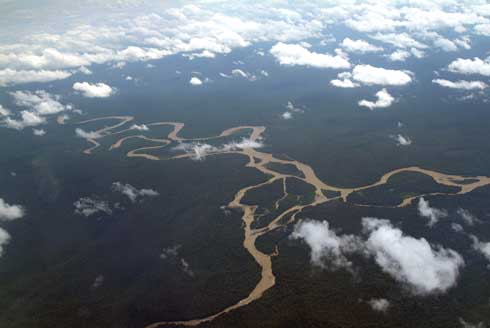
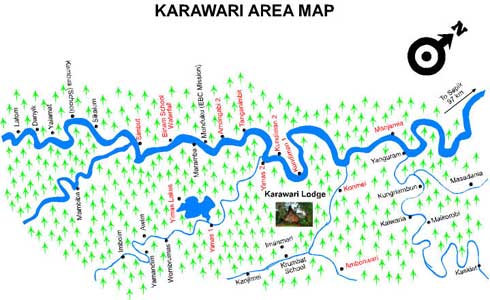
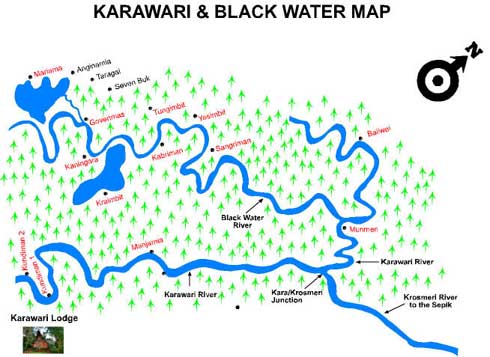
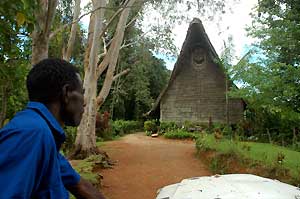 Karawari Lodge stands majestically on a lone ridge amidst a vast expanse of dense tropical lowland Sepik Basin rainforest which extends beyond the horizon for, what seems like, a thousand miles in every direction.
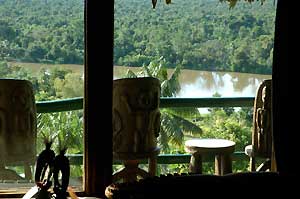 his tropical lowland rainforest is one of earth's most complex of habitats, housing an immense variety of flora and fauna along with a unique culture.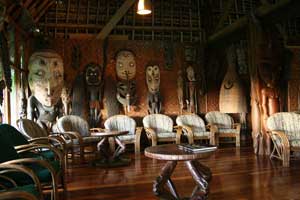
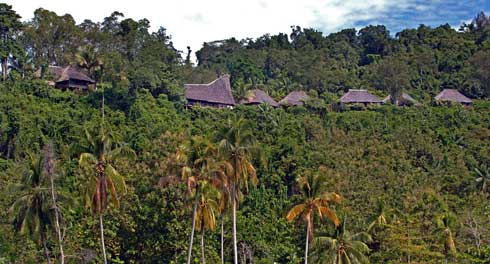
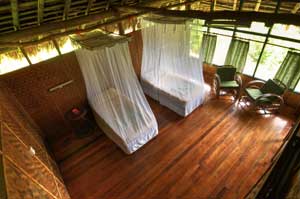 Your cottage, nestled in the spacious gardens, is constructed from locally gathered bush materials and fashioned after the traditional houses, yet having all the luxuries including a modern bathroom, comfortable mosquito-netted beds, ceiling fans, and a breezy verandah. All a welcome sanctuary after a day's exploration.
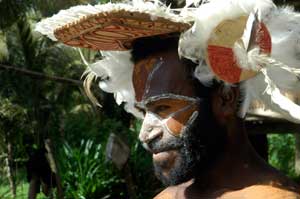 From Karawari, the awe inspiring beauty of the view at dusk has to be experienced to be believed. While contemplating the vast expanse of jungle as the setting sun colors the clouds and snaking river below, one could almost believe that the world was born yesterday.
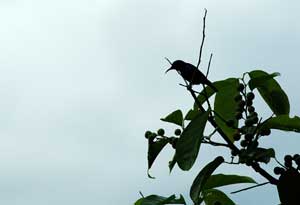 An Optional village stay in a traditional village for 2 days/1 night in a traditional village is also possible from Karawari.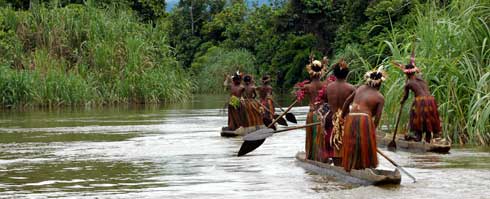
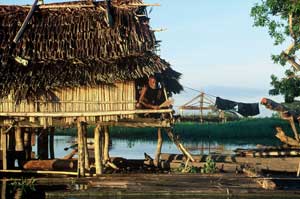 Luxury in the deepest Sepik...
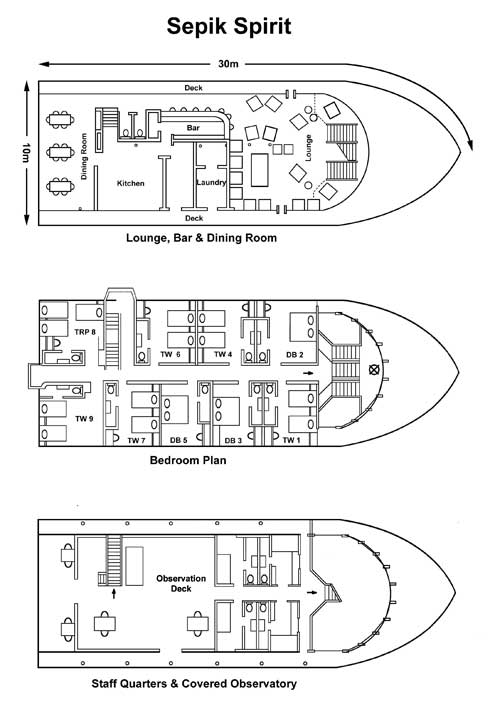
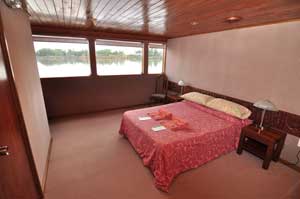 In its new role as a "floating lodge" fixed in the middle Sepik, the Sepik Spirit offers greater booking flexibility, enhanced touring programs and even more comfort. Returning travelers will note the updated decor. As for the Sepik Spirit's renowned hospitality, some new flourishes have been added.
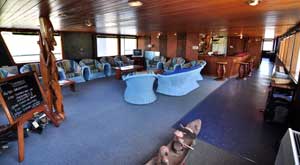 From their base on the Sepik Spirit, guests explore the Sepik River and the connecting tributaries and lakes on eighteen seat jet-boats. These boats have shallow drafts and the ability to maneuver where large vessels cannot go.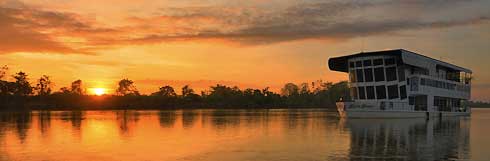
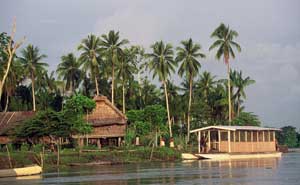 Visit Spirit Houses decorated with carved ancestral figures. Hear the sounds of massive garamut drums and mysterious ritual flutes and rhythmic rattle of dancers' shell jewelry. Sepik Spirit guides and village elders will give you insight into the culture, totems and ceremonies.
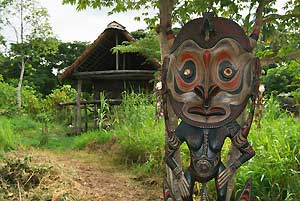 Marvel at the creativity that thrives in this tropical environment. The region is a gallery of tribal art. Every village boasts its own style and nearly every villager is an artisan.
 The Sepik Spirit's nine spacious rooms accommodate a maximum of just eighteen guests. Each has an en-suite bathroom, large windows and personally controlled air-conditioning.
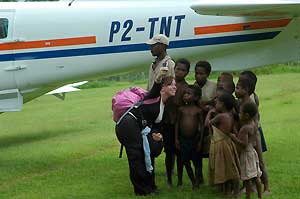
The Sepik Spirit is accessible by private air service. Flights depart from Mount Hagen, where Rondon Ridge is located, and from Karawari Lodge and Ambua Lodge. Charter flights from other departure points can be arranged.
The Sepik Spirit's nine spacious rooms accommodate a maximum of just eighteen guests. Each has an en-suite bathroom, large windows and personally controlled air-conditioning.
The Sepik Spirit is accessible by private air service. Flights depart from Mount Hagen, where Rondon Ridge is located, and from Karawari Lodge and Ambua Lodge. Charter flights from other departure points can be arranged.