
Choose Your Activity
Choose Where You Sleep
- Amira
- Arenui
- Aurora
- Damai
- Euphoria
- Indo Siren
- Mermaid I
- Mermaid II
- Ondina
- Pearl of Papua
- Putiraja
- Putri Papua
- Raja Ampat Agressor
- Raja Ampat Explorer
- Sea Safari 8
- Seahorse
- Shakti
- Tambora
- Temukira
Indonesia Liveaboard Diving
Choose where you sleep
- Amira
- Arenui
- Aurora
- Damai
- Euphoria
- Indo Siren
- Mermaid I
- Mermaid II
- Ondina
- Pearl of Papua
- Putiraja
- Putri Papua
- Raja Ampat Agressor
- Raja Ampat Explorer
- Sea Safari 8
- Seahorse
- Shakti
- Tambora
- Temukira
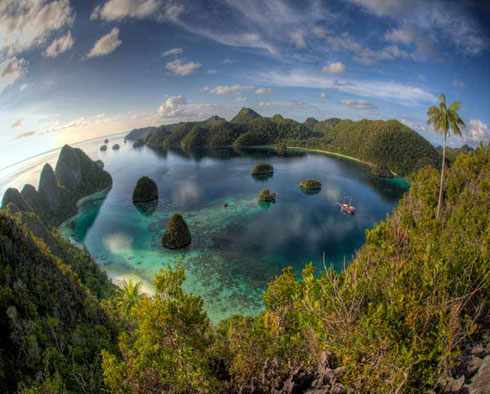
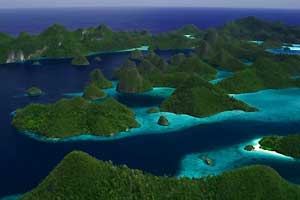 The Raja Ampat island group in Indonesia's West Papua province is known for its incredible biodiversity but yet still remains unspoiled by tourism. By joining a liveaboard dive cruise, you can be one of the first to visit this beautiful island group and experience genuinely pristine environments both below and above the water.
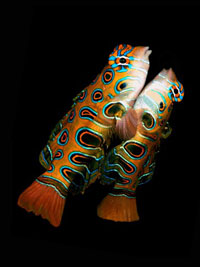
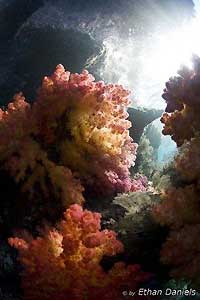 Whether your preference is for macro photography or for action packed big fish diving you will not be disappointed. The larger species you are likely to encounter include giant Mantas, Mobula rays (often in large numbers), large schools of Barracuda, Jacks, Mackeral, as well as Wobbegong sharks, Tawny sharks and many others. Macro enthusiasts can see Blue Ringed Octopus, Mimic Octopus, numerous types of Pygmy Seahorse, Ghost Pipefish, Frogfish, Mandarin fish and a huge variety of strange and wonderful molluscs and crustaceans.
A biodiversity survey conducted by “Conservation International”, suggests that "due to it's location near the heart of the coral triangle coupled with an amazing diversity of  marine habitats, the area is potentially the world's richest in terms of marine biodiversity" - Mc Kenna, Allen and Suryadi (April 2002). The findings of this project showed more species diversity than any other area previously surveyed worldwide. A similar survey was repeated the following year by a different independent NGO, The Nature Conservancy, which also concluded that Raja Ampat has the highest biodiversity of both fish, and coral
 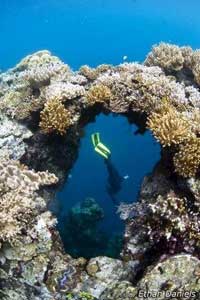 species. To date, there are a known total of 970 fish species, 565 hard coral species and 699 species of molluscs.
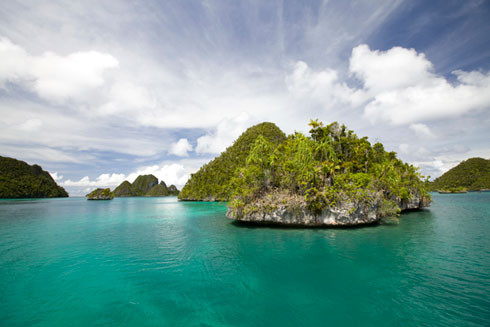
Above the surface, the Raja Ampat islands offer some of the most beautiful and dramatic island scenery to be found anywhere. Shakti's itineraries offer a chance to see completely untouched rainforest and mangrove environments as well as dramatic karst limestone island groups. These forests are home to some of the world’s rarest and most exotic bird species which include various types of Parrots, Cockatoos and the famous Birds of Paradise.
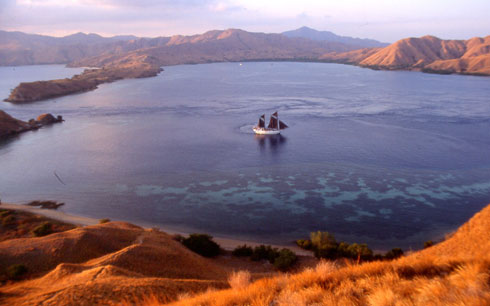
Truly frontier diving a very few years ago, there is now a broad choice of liveaboard dive boats to choose from operating in and 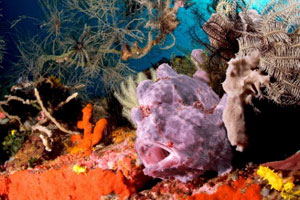 around Raja Ampat, Misool and the Birdshead peninsular of West Papua Province, Indonesia. Amongst these is a fleet of traditional-style “pinisi” (pronounced finisi) sailing schooners hailing from the great Bugis boat builders of Southern Sulawesi, some of which are furnished to almost opulent levels of comfort.
 Cruises typically range from ten days to two weeks in duration, but longer cruises can be found. Many boats are available for charter if you ask long enough in advance of the sailing season.
We list some of our favourite operators here, but if you can’t find a schedule to fit your needs, please ask as this is not an exhaustive list.
Details of the scheduled cruises can be found in the timetable below, while descriptions of the vessels are found via links on the right hand side. Some of the boats not featured below may be available for charter only.
Please check the Deals4Divers blog to see if there are any current great deals going for liveaboards in Raja Ampat. You can also follow Deals4Divers on Twitter or Facebook.
Notes
Shakti
Sample 12 Day Cruise Itinierary on the Shakti
 Day 1: Board Shakti in Sorong
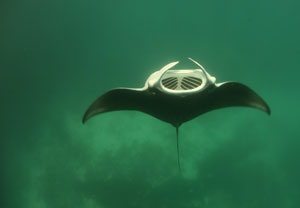
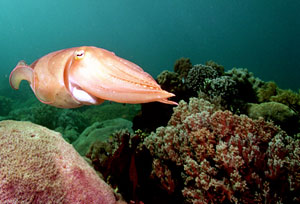
Day 2: After an early morning sail we arrive at Manta point, where some channels between a shallow reef systems provide a good place for manta's and other large rays to hang in the current feeding on plankton, and a perfect place for us to dive with them! Our second dive is at Andy's reef. A ridge, which rises out of deep water 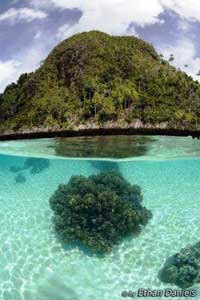 to 8m and slopes off steeply on each side. This ridge provides a home for thousands of fish both big and small. As the current picks up huge shoals of silverside and the smaller fish come close to the reefs, flashing as the sunlight catches them, as they avoid the big hunting Tuna's and Jacks. Our third dive is at Fam wall, a excellent place to spot some more unusual critters such as, Mandarin fish and juvenile cuttle fish hiding amongst the coral at the bottom of the wall.
Day 3: South Fam Wall, a great dive starting just before the point where there?s lots a action as the big fish hunt in the current. Drifting around the corner and out of the current we can explore all the excellent macro life on the wall. This site you can 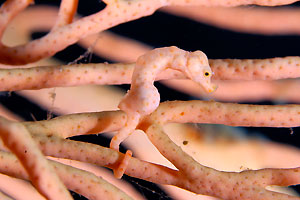 find the rare yellow pigmy seahorse and lots of other critter such as Orang utan crabs and many nudibranchs. The second dive is called Melissa?s garden, and it really is a garden! Hardly a spot that isn?t covered in soft, hard or fan corals. Our third dive is another Garden, this time Anita?s garden, a great relaxing afternoon dive looking for Wobbigong sharks that lie in wait for their prey under big coral blocks.
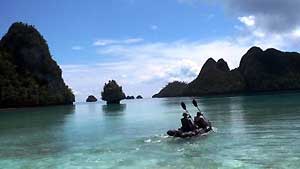 Day 4: Equator Islands is our first dive. Literally a chance to dive across the equator! Possible to find Harlequin shrimps hiding under rocks in the shallows at the end of the dive. An adrenalin packed second dive at white rock. Huge schools of Jacks, surgeon fish, barracuda, and dog tooth tuna keep you company as you watch out for the occasional big gray reef
 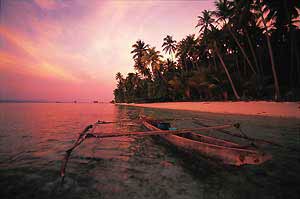 shark to come cruising by. Our last dive is around a tiny islet with a single tree on it, hence the name, ?one tree rock? Very interesting topography, with walls, slopes, flats, caverns and huge boulders all on one dive!
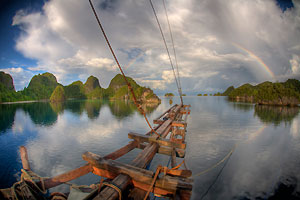
Day 5: We arrive in Wayag, a stunning group of islands formed from Karst limestone and covered in jungle. The main island has many beautiful lagoons with 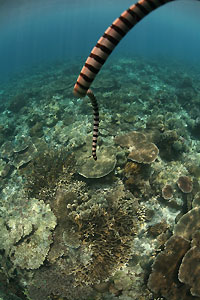 hundreds of tiny mushroom shaped islets dotted around in the still blue water. This breathtaking scenery is often compared to Pulau's famous islands and described as a "James Bond" set! First dive is a small island just to the north west of Wayag. A steep wall drops to 35m where huge house like boulders are home to giant dogtooth tunas and trevalleys. Another island with no name is the site for the second dive, following the slope down the west side we come to a large underwater sea mound covered in big sea fans and coral.
The last dive is at Twin Island, one of the most beautiful coral dives of the trip. A shallow slope to the south of the island has a magnificent coral 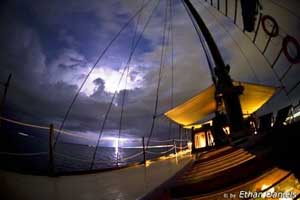 garden, crammed with table coral, soft and fan corals. There are always big schools of surgeonfish and midnight, Andaman and lined sweet lips to keep you company, and for the macro photographers this is a great place to spot some of the more unusual nudibranches.
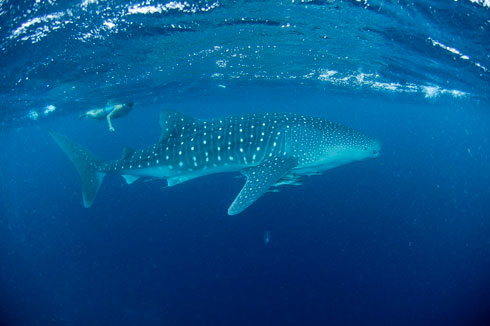
Day 6: The first dive of the morning is close to the anchorage, a beautiful reef around one of the many unique mushroom shaped islands that are dotted around Wayag Island. For the second dive we 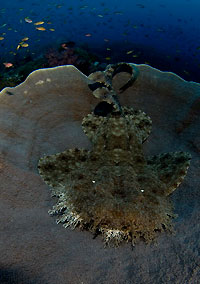 sail around to the east of Wayag Island, a good chance to get some above water photos of the stunning top side scenery. This dive is full of surprises as the topography is continually changing. We drift along a vertical wall to start the dive, and as we round the small island there is a huge arch, big enough for a bus to drive through!! As we swim through the arch, there are small caves in the island on the other side, with every type of snapper you?ve ever seen and much more. It is also a good place to see gray reef sharks and mantas cruising past in the blue water beyond the arch.
The afternoon dive is another beautiful coral slope. There is a huge garden of hard corals swarming with anthias and other reef fish. Huge schools of red tooth trigger and surgeon fish cover the slope, and the occasional pelagic Spanish mackerel.
 Day 7: The first dive of the day is at Split Island, literally an island that has been almost split in two. The dramatic topography continues underwater, with huge boulders and caverns. After a short sail we arrive at Quoy Island. Here we first dive the north east point. This dive starts with a vertical wall on the north side, and as we drift to the south with the current, we pass a huge cavern and many smaller caves. Large schools of fish, aggregate on the point and many sweetlips shelter from the current in the small caves.
The afternoon dive is a very relaxing dive along the south of Quoy Island. The reef here is a gentle slope, and is covered in hard and soft corals. At about 20m the slope flattens out and sand stretches out as far as the eye can see. Often big reef rays can be seen if you swim out over the sand.
Day 8: A lovely dive off the south east of Quoy Island. A coral slope that ends in white sand at 45m. Following the slope to the south brings us to a point where there?s always good fish action. Our second dive is on the north east of Uranie Island. We enter under a split in the cliff face. At 25m the split opens up into a huge cavern, with shafts of light filtering through the cracks in the roof. Always lots of sweetlips sheltering from the current, and normally two or three sleeping nurse sharks. Great for photographers who can get within touching distance of the sharks without disturbing their slumber. Another relaxing afternoon dive on a shallow coral plateau in Uraine bay makes a perfect end to the day.
Day 9: The morning dive is adrenaline packed, diving a small islet in the channel between Uranie Island and Quoy Island. This channel gets quite a lot of current and hence many of the big fish, mackerels, Jacks and Tunas hang in the current hunting the thousands of schooling fish. Often large grey reef sharks cruise by keeping an eye on their territory! The second dive is at Eagle Island, another small islet in the same channel. This place is great to spot the most majestic of marine animals, the Manta ray. Often these beautiful creatures glide back and forth this site scooping huge mouthfuls of plankton up with their mandibles. The afternoon dive is in the northern mouth of Uranie bay. Here is a good place to see guitar sharks and wobbigongs that Irian is famous for. Many other unusual critters can be spotted such as wasp fish and stargazers.
Day 10: West Papua is famed not only for its outstanding coral reefs but also for its wrecks. During World War 2 Irian was an important base for both American and Japanese ships and planes. The consequential battles have left many fantastic wrecks in this area from fighter planes to warships. The first two dives are on American P 47D fighter planes. Three American planes caught in a dogfight found them without enough fuel to return to their base; and decided to crash land near the same small island. They all made it to within meters of the beach and all survived! As the planes are almost completely intact they make excellent dives. Last dive of the trip is Nixon?s Reef. A great dive to end on, teaming with fish and many white tips, black tips and grey sharks.
Day 11: The eastern most tip of Kri Island is action packed dive for even the most traveled diver. Strong currents sweeping around this point make it home for practically every fish you've ever seen! Gerry Allan the famous author of several fish books, broke his lifetime record and counted an unbelievable 273? Different species of fish on one dive! Our next dive at Sardine reef is just as exciting, expect to see, schools of chevron and giantbarracudas, huge schools of Jacks, Spanish mackerels, tunas, sweetlips and black and white tip sharks as well as hundreds of others! If you manage to take you eyes of the action for a second then you are likely to find many nudibrachs, flat worms and leaf scorpion fish as well.
Day 12: Transfer to airport / departure.
Services Include:
- Transfers from/to Airport
- Towels & Linen (several changes during the trip)
- 3 full meals each day + snacks
- Use of sea kayaks
Services exclude:
- Nitrox
- Dive Equipment rental*
- Beer (2,-Eur), Softdrinks (1,-Eur), Juices (0,80 Eur)
- Raja Ampat Marine protected Area Tax System**
* Dive Equipment RENTAL
20,- Euro / day Ful Set (excl. Computer)
8,- Euro / day Regulator
8,- Euro / day BCD
4,- Euro / day Mask & Snorkel
5,- Euro / day Computer
4,- Euro / day Fins & Booties
** Raja Ampat Marine protected Area Tax System**
Please be advised that as of Sept 2007 all visitors to Raja Ampat are required by law to purchase an entrance tag. Tags cost Rp 500.000,- and are valid for one year. All proceeds are administered by conservation international for management of Raja Ampats marine protected areas.
Notes
Shakti is available for charter for groups of up to 10 friends. The cruise director will design your unique cruise in Raja Ampat according to your personal interests and individual wishes in terms of activities.Temukira
Sample 11 Day – 10 Night Raja Ampa, West Papua (formerly Irian Jaya)
Day 1 From Jakarta, Makassar or Manado – Sorong - Raja Ampat
Arrive Sorong. Transfer to boat. Depart for Raja Ampat. Begin dive program. Meals on board.
Day 2 through Day 9 Raja Ampat
Full dive schedule. Meals on board.
Day 10 Raja Ampat – Sorong
Morning dives. Meals on board. Overnight on the stay on the boat.
Day 11 Depart Sorong
Breakfast on board. Disembark, travel to Sorong’s airport for flight to Jakarta, Denpasar or Manado.
Seahorse
Raja Ampat in eastern Indonesia offers some of the best diving in the world, notably the islands off the western tip of Papua, where Conservation International conducted a tropical reef biodiversity count revealing the richest diversity of coral and coral reef fish species yet counted in a single location.
MSY SEAHORSE - Raja Ampat/Cendrawasih Bay & Banda Sea RATES
USD $400 pp/per day/Twin Share Cabin
USD $420 pp/per day/Double Cabin
- FULL CHARTER/16 pax/8 cabins/per night @ USD $5,600(PAY 14 FOC 02)
- HALF CHARTER/08 pax/4 cabins/per night @ USD $3,200(PAY 07 FOC 01)
Additional charges:
- NITROX: USD $180 per person (10 days), or USD $125 per person (7 days)
- Raja Ampat Port & Park Fees USD $190 per person & Fuel Surcharge: USD $160
- Cendrawasih Bay Port & Park Fee USD $275 per person & Fuel Surcharge USD $160 per person
- Raja Ampat, Ambon, Banda Sea Port & Park Fee USD $275 per person & Fuel Surcharge USD $TBA
CRUISE PRICES INCLUDE:
- Accommodations aboard the yacht
- Diving: 4 guided dives at day
- Compressed air tanks, weights & weight belts
- Airport and/or Hotel transfers on day of charter
- All meals and snacks
CRUISE PRICES DO NOT INCLUDE:
- Airfare (international and domestic)
- Equipment rentals
- Nitrox fills (subject to additional charge - see above)
- Certification or specialty courses
- Hotel stays/day room prior & after cruise date
- Crew gratuity
- Equipment rentals
- Port/park fees, fuel surcharge, taxes (when applicable - see above)
Notes:
- Rates are based on double occupancy
- All prices quoted USD $
- Rates are subject to change without notice
- Single Supplement: 50% surcharge based on full charter rate. Guarantees an individual traveler a private room
Tambora
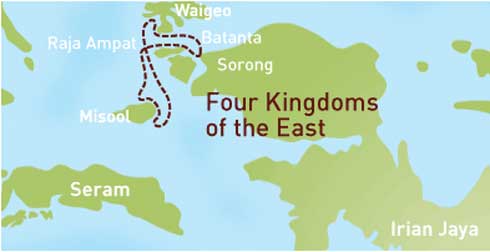
Four Kingdoms of the East - Dive Raja Ampat
Raja Empat has only fairly recently been discovered as scuba diving’s new frontier, and has very quickly gained a reputation as one of the world’s finest dive areas, perhaps the finest amongst all in terms of biodiversity. New species keep being discovered here, and considering the vast geographic expanse of this group of islands, this is set to continue for years and years!
Our cruises depart from and return to Sorong, the area’s major town on the tip of the Bird’s Head Peninsula. Soon upon leaving Sorong harbor, Tambora will sail in crystal clear waters, among an endless string of densely forested and mostly uninhabited islands. The vast expanse and sheer number of islands allows us to pick itineraries and dive sites that suit during any season.
We will start things off diving the superb sites of the Dampier Strait. This is where waters from the Pacific and the inner Indonesian Seas first meet, providing for an extreme wealth of marine creatures including manta rays, schooling trevally and jacks, reef sharks, and the bizarre wobbegong shark. From here, cruises continue southwards towards Misool and the labyrinth of little islets surrounding it (Note: cruises in the June-August time period will turn north towards Waigeo and Wayag). You can expect it all – big pelagics, reefs teeming with life, great macro sites, and vibrantly colored night dives!
From Sorong, the major town on the Bird’s Head Peninsula and in the West of Indonesian New Guinea, you can connect easily to destinations across Indonesia.
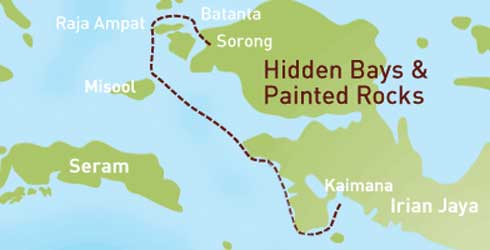
Hidden Bays & Painted Rocks - From Raja Ampat to Triton Bay
This cruise between Sorong and Kaimana takes Tambora along the West Papua coast and through south and central Raja Ampat to some of the world’s very best, yet at the same time very little dived, sites.
Depart Kaimana bound southwards along the towering West papua coastline. A backdrop of steep limestone cliffs topped by pristine rain forest make for eerie scenery; oftentimes for kilometres, galleries of rock paintings delineate ancient burial grounds. The sea below is rich in nutrients and offers stunning biodiversity.
Explore Triton and Aetna Bays, with exuberant coral gardens and an amazing array of reef fish as well as lots of pelagic action.
Turning around to head back North, Tambora will spend a number of days in the Southern part of Raja Ampat, diving Misool and the labyrinth of islets and rocks surrounding it. The surface and underwater scenery are equally pristine, and each and every anchorage will be a picture-book experience. The ensuing leg of the cruise takes Tambodia further up north, through the Dampier Strait and to the spectacular dive sites at Fam, Mansuar, Sardines Reef, and Cape Kri. Expect an endless variety of fish, including manta rays, dogtooth tuna giant trevally, the shy napoleon fish, and the bizarre wobbegong shark.
From Sorong, the major town on the Bird’s Head Peninsula and in the West of Indonesian New Guinea, you can connect easily to destinations across Indonesia.
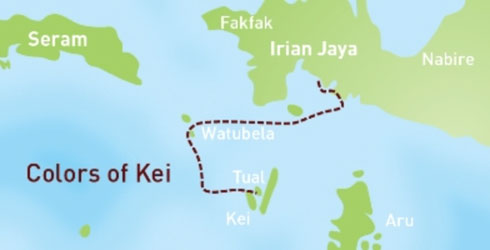
Colours of Kei - Eastern Banda Sea & Triton Bay
The cruise ‘Colours of Kei’ combines two dive regions that are both world class but very different one from another: the chain of islands at the eastern border of the Banda Sea; and, Triton Bay, just off the Papuan mainland.
Tambora’s cruise commences in Tual, the main city in the Kei Islands group which are known for their large population of leatherback turtles. Soon upon leaving Tual, you will start diving the many surrounding islands and islets; some of the diving here still has exploration character since the area is very rarely visited let alone dived. Moving north, you will next dive the Watubela chain of islands; here, crystal clear water, steep walls, and some of the most amazing table coral gardens await. When the currents are running, there is a fair chance of seeing batteries of barracuda and the biggest Napoleon wrasses found anywhere!
Leaving the Moluccas, Tabora will cross over to the Papuan mainland and Triton Bay to experience a very different scenery both above and below the waterline: densely forested mountains, their peaks more often than not veiled in clouds, make a dramatic backdrop to underwater slopes alive with the most delicate and colourful soft corals over which big schools of fish are feeding and hunting. Given the close proximity to the mainland, visibility varies significantly, and we will need to select our sites and time our dives with this in mind.
On the day prior to disembarkation, visit the huge limestone labyrinth inside the bay before pulling into Kaimana. From here, you can continue to Ambon, Sorong or Jakarta. Tual, the port of embarkation, can easily be reached by plane from Jakarta or Ambon.
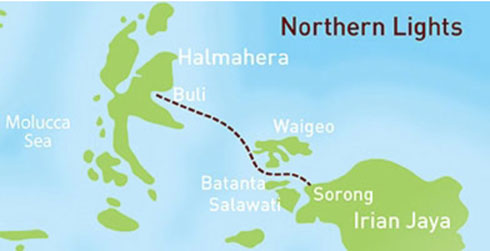
Northern Lights - Dive and Explore the Extreme North of Raja Ampat and Halmahera's Buli Bay
This newly designed cruise itinerary will combine North Raja Ampat - both known highlights including Kawe, the Equator Islands and Wayag as well as the currently undived archipelagos further North and West - with Eastern Halmahera’s Buli Bay.
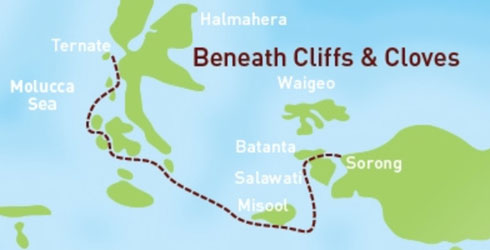
Beneath Cliffs and Cloves either starts or ends in West Papua that includes some of the best dives in the southern Raja Ampat islands.
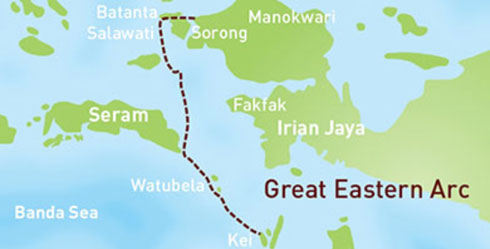
Great Eastern Arc - From South Raja Ampat via Seram Laut and Watubela into Kei
Tambora’s itinerary, ‘Great Eastern Arc’, combines two world class dive regions in a single cruise: the Southern islands of Raja Ampat and the Eastern rim of the Banda Sea. Both areas have their own unique attractions, and hence this itinerary offers some of the best diving in the country along many different dimensions.
Upon leaving Sorong, our first stop is at the Southern shores of the island of Batanta, one of the 4 Kings comprising Raja Ampat. Dive a series of black sand bays, a prime habit for critters like nudibranches, ghost pipefish and seahorses. Next, an overnight passage brings Tambora to the karst island-dotted seascape lying to the East of Misool. Over the next couple of days you can sample some of the best dive sites in all of Raja Ampat, with brilliantly coloured soft corals and myriads of schooling fish.
From Misool sail across the Seram Sea to reach the small island of Koon in the Seram Laut Group. Here, strong currents from deep create an environment that attracts feeding fish, big and small.
Continuing on further south along the Great Eastern Arc, Tambora will reach the Watubela chain of islands. Crystal clear water with 40m + visibility, steep walls, stunning underwater rock formations, and some of the best hard coral gardens await us here. What’s more, large batteries of barracuda and big gatherings of Napoleon wrasses are also among the highlights of diving Watubela.
The night before disembarkation, the Tambora we will pull into Tual harbor, from where you can catch your flight back into Ambon and onwards across Indonesia.
Siren
Raja Ampat is all about diversity, not only of marine species but also of dive sites. Recently declared a marine sanctuary to 46,000 square km park gives you wildly different dive experiences. From pelagic drift dives to magical muck dives and even some habitats that are special to Raja Ampat such as clear water mangroves with corals growing right next to them. There are thousands of potential dive sites in Raja Ampat. Exploration is still continuing and on every trip there are chances for new and amazing discoveries.
Departing from Sorong the S/Y Indo Siren cruises southwards towards Misool, stopping for "muck" dives on the dark sand slopes of Batanta where its critters galore! Then all divers will spend up to 3 days diving a variety of sites in the Misool area for their stunning corals, including Boo Windows and Gorgonian Passage where sea fans dominate the scenery.
Heading back northwards the liveaboard will take guests to dive around Fam Penemu & Yangeffo islands. Here you can find the site of Citrus Ridge, where carpets of brightly coloured soft corals can be found close to the surface which, illuminated by natural sunlight, make this dive site spectacularly beautiful. There is time for snorkeling in the mangroves and a visit to tiny Airborek Island along with a dusk dive at the pier before heading on to Mansuar for some manta ray action at Manta Sandy.
In the Dampier Strait there are fish… and lots of them! In more shapes and sizes than anywhere else in the world. Not only are there numerous species, but all levels of the food chain are well represented, from pygmy seahorses to larger pelagic. The most famous sites include Cape Kri and Sardine reef where speedy drifts dive can be expected.
The reefs in Raja Ampat just buzz with life! Manta rays, wobbegong sharks and epaulette sharks can all be found in the waters of the Four Kings.
RA Explorer
Sample Iinerary Raja Ampat Itinerary
11 Day – 10 Night PAPUA RajaAmpat
Day 1 From Jakarta or Ujungpandang or Manado – Sorong - RajaAmpat. Arrive Sorong and transfer to the Raja Ampat Explorer. Depart for Raja Ampat. Begin dive program. Meals onboard.
Day 2 through Day 9 Diving Raja Ampat
Full dive schedule. Meals onboard.
Day 10 Raja Ampat – Sorong
Morning dives. Meals onboard. Overnight on the stay on the boat.
Day 11 Sorong – Manado / Jakarta / Denpasar
Breakfast onboard. Disembark, travel to Sorong’s airport for flight to Jakarta or Denpasar or Manado.
Raja Ampat Combo
The RAJA AMPAT COMBO is a 7 night program on liveaboard combined with a 3 night dive program at Raja Ampat Dive Lodge. A total of 11day - 10 night package with maximum 4 dives each day. Combos that include Wayag or Misool can be selected from the above schedule.
Aurora
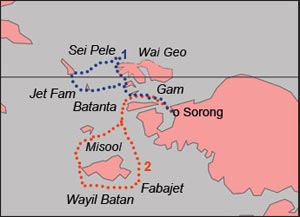 The huge area of Raja Ampat represents a big marine reserve, that stretches out to the north (Waigeo and neighbouring island) and to the south-west (Misool). The whole region is a labyrinth of straits between small sandstone islands, eroded by the waves. The dry season is between September to March, however rain falls are to be expected throughout the whole year.
Routes and dates
Two routes: North and South, departing from and returning to Sorong.
Raja Ampat North: Sorong - Jef Fam - Kawe - Wajak - Coquille Uranie - Sei Pele - Wafak - Mansouthar - Kri - Sorong.
Raja Ampat South: Sorong - Farondi - Misool - Fiabajet - Jef Fam - Mansouthar - Kri - Sorong
Notes
Prices do not include fuel surcharges and National Park entry feesSea Safari 8
This liveaboard scuba diving adventure with Sea Safari VIII to Raja Ampat starts and ends at the small port town of Sorong in West Papua (formerly known as Irian Jaya), and takes you to an amazing array of unique dive sites, including Kri Island, Wayag, East and West Misool, Batanta and Gam Islands.
Sample 12 Day Itinerary
Day 1: Arrival Sorong Airport
The crew will meet you at the airport and escort you to the ship for boarding. Cabin allocation and ship orientation will take place before departure at 3:00 PM. Take this opportunity to familiarize yourselves with the vessel, set up your equipment, and make yourself comfortable. Dinner will be served while sailing towards the first destination.
Day 2: Kri Island
Welcome to Kri Island. The reefs in this area are protected by Max Ammer from the Papua Diving Resort. If you would like to add some diving days before the cruise you can just stay at this resort and join the boat right outside the Lagoon. Kri is a great start for the cruise with the most fish and coral species accounted on a single divesite. Truly pristine reefs, you will want to dive these sites around this island again and again. A night dive will be offered.
Days 3 & 4: Waigeo Island Group
Welcome to the incredible Waigeo Island group. You will be in awe at the beauty of yellow Wall boasting a very large amount of yellow soft coral. In the afternoon a dive on the sheer wall undercut at the edge from millions of years of oceanic erosion will truly amaze. An interesting pearl farm is nearby (the 5th biggest in Asia) and can be visited upon request. The night dive here is not to be missed! The chances to see bigger animals including mantas are high in this area.
Day 5: Kawe Island
Draping directly over the equator lies Kawe Island. The ship will arrive early morning in and anchor right on the equator. Enjoy breakfast while watching the stunning scenery. You will be offered up to five dives today to take advantage of this world-class dive region, with a treat to an enormous array of fish life as well as stunning scenery above water.
Days 6 & 7: Waiag And Southern Islands
Continuing the cruise onto the most northerly area of Irian Jaya with many unnamed groups of islets. From mild sloping coral gardens with huge coral rocks and colorful soft corals, to steep walls and schooling fish, this region is truly spectacular. Here you can make the famous ‘hike” to view the breath taking scenery over the island group here. Fantastic night dives with rare wobbygong shark spottings are also on the agenda.
Days 8 & 9: Manosuar Island
Arriving early morning in Manosuar, you can expect to dive the famous sardine reef as well as 3 other incredible sites. The fish life is prolific and the topside scenery will truly astound. Two full days diving will be offered in this amazing region as well as a great top deck barbeque to satisfy those hungry divers.
Day 10: Batanta Island
To start your day, you will take a two hour morning hike in search of the Red Bird of Paradise. A true jungle trek, you will hear giant hornbills, cockatoos flying by and perhaps if lucky, the mesmerizing song of the bird of Paradise. Today’s diving day can host anything from wobbygong sharks to pigmy seahorses.
Day 11: Wai Island
After a light breakfast, a beautiful dive will be offered at the American plane wreck that crashed in these waters in the 1940’s. The wreck is upside down and between 24 - 34 m (90-115’) deep. The wreck is fairly intact with excellent coral covering it especially on the lower side of the tail section. The guns are also visible on this truly great dive. The rest of the day will be spent around the incredible sites of Wai Island. If desired, you may take a short trip on shore to see the resident cassowary bird.
Day 12: Arrival in Sorong
The ship will arrive at 6:00 AM at Sorong. Breakfast will be served and afterwards prepare for disembarkation. Transfer to the airport for your onward flight.
Variations
The Irian Jaya - Raja Ampat liveaboard is usually an eleven night cruise but in case of twelve night cruises, there will be an extra night at Wei Island on day twelve and arrive in Sorong on day thirteen.
Notes
Surcharge: USD. 250 per person for port clearance & the marine park feeRaja Ampat Agressor
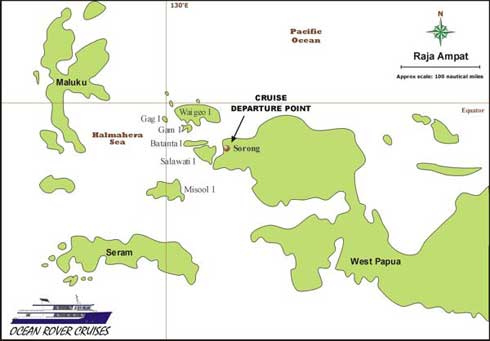
Waigeo, Gam, Kri, Wai, Batanta, Kawe and more
Ocean Rover's East Indonesia cruises visit the best sites of Raja Ampat. Diving here means diving with sometimes strong currents and, for that reason we have to remain flexible. THe dive guides will be check regularly and, if too strong, the dive director will make the decision to move to another location. The next great dive site is waiting just around the corner!
On cruise departure day, Ocean Rover's staff will pick up guests from the airport or from a local hotel if they arrived a few days earlier. After all have boarded, there will be a welcome aboard briefing at approx. 1800hrs before getting underway.
During the itinerary, Ocean Rover will cross the equator several times between the longitudes 130°-132°E while enjoying the best of the underwater world of Raja Ampat’s many dive sites, predominately in the north-west region around the islands of Waigeo, Gam, Kri, Wai, Fam and Kawe.
On disembarkation day some passengers may have to rise extra early because of flights leaving in the morning. Guests who are staying in Sorong longer may disembark after breakfast.
A typical 12 day itinerary will net you 45 to 54 dives (night dives only where a location is suitable).
These Ocean Rover dive cruises to Raja Ampat are NOT RECOMMENDED for Inexperienced Divers
Notes
To celebrate Ocean Rover's 10th Birthday cruising in Indonesia, book any Ocean Rover 2011 or 2012 cruise before 31 December 2011 and get a 10% discount off the prices shown below!!Mermaid I
Sample 10 Day cruise with Mermaid I
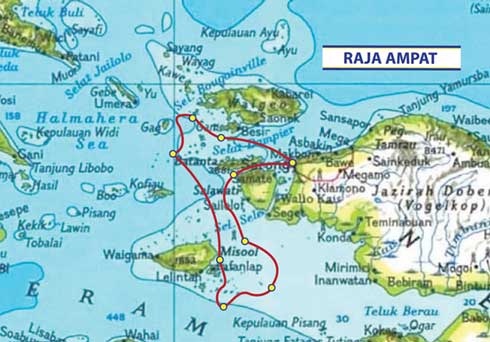
Raja Ampat ~ Raja Ampat: 10 days/9 nights:
Day 1 - (Dives: 0): Check-in on board MV Mermaid I. As guest arrivals take place all through the day depending on flights you are welcome to board when you arrive and spend some time looking around Sorong, gearing up etc. Following the boat and safety briefing - its overnight to the Misool area.
It is almost impossible to put together a daily itinerary due to the magnificent diving everywhere we go. No trip is the same with so many different sites to visit and explore. If there is somewhere in particular you really have your heart set on please discuss with the Cruise Director who will do their utmost to get you there – conditions, ship and your safety allowing!
Day 2-4 - (Dives: 12): Misool area – with literally 100’s of dives around this magnificent area we will be in diver’s paradise for a few days. Soft corals, gorgonians – some of the pretties corals in the world – and the kingdom of the pygmy seahorse ! Pinnacles with masses of fish. Blue water mangroves (crocs depending !) Islands we will thoroughly enjoy the Misool area including Sagof Islands, Wagma and Farondi islands; Wailbatan and Warakaret Island, Kalig, Pele Islands.
Day 5-8 - (Dives: 18): Fiabacet and Farondi Islands and after the 3rd dive of the day spend some time going around the lagoons in the dinghy for amazing sights and wildlife. Then we may head north to Waigeo Island. Perhaps we will spend the day around Batanta Island, a black sand environment – great muck diving ! The Mantas call us to Dampier Strait where they hang out at their cleaning stations. But this place is also fabulous for macro diving with critters such as Pegasus, Pontohi Pgymy Seahorse, pipefish etc. And two dives at a small island called Arborek, with a lovely village and a jetty great for diving ! The jetty pillars are covered in soft corals – a photographer’s delight and also good for macro such as signal gobies, nudibrancs and more Pohtohi’s etc. Dive around the island of Kawe a great place for schooling fish, and beautiful reefs covered in black coral bushes. And dive Alyui Bay (or a full day around Alyui Bay). In Alyui Bay there is a pearl farm. We can tour the pearl farm and learn how they harvest the pearls, and the whole process of pearl farming. You can even buy pearls. Diving in Alyui bay is good for macro and wide angle. Walls covered in soft corals and sea fans with lots of nudies and pygmys. Also a great night dive in the jetty; Raja Epaulette Shark (walking sharks), wobbegongs, crocodilefish, toadfish and frogfish.
Dive around the island of Yanggefo - beautiful mangrove areas, stunning reefs covered in orange and pruple soft corals, and submerged reef with lots of schooling fish, and pygmies.The Strait of Dampier are also well known for the amount of schooling fish. There are several pinnacles with zillions of fish . Also the tips (capes) of several islands with again lots of schooling fish; schools of barracudas, school of bigeye jacks, snappers, zillions of fusiliers and surgeonfish, etc…. And lots of wobbegongs.
Day 9 - (Dives: 2): 2 dives in the Strait of Dampier. More of the same. Fish, fish, fish, glorious corals and all ! Then back to Sorong we must go. The crew will take care of rinsing and packing your equipment during this 4-5 hour run.
Day 10 - (Dives: 0): After breakfast, transfer you ashore for disembarkation.
TOTAL DIVES: 32
2017 & 2018 PRICES (EUR):
| Route | D/N | Master | Single | Deluxe | Budget |
| Roaja Ampat | 11/10 | 4,100 | 4,100 | 3,700 | 3,300 |
| Raja Ampat ~ Halmahera ~ Lembeh or reverse |
12/11 | 4,900 | 4,900 | 4,500 | 4,100 |
| Raja Ampat ~ Banda Sea ~ Ambon or reverse |
12/11 | 4,900 | 4,900 | 4,500 | 4,100 |
| Biodiversity Special | 16/15 | 5,400 | 5,400 | 5,000 | 4,600 |
Mermaid II
Sample 9 day cruise with Mermaid II
SORONG-RAJA AMPAT-SORONG – 9 DAYS/ 8 NIGHTS
Day 1 (Dives: 0): Check-in on board MV Mermaid I. As guest arrivals take place all through the day depending on flights you are welcome to board when you arrive and spend some time looking around Sorong, gearing up etc. Following the boat and safety briefing – its overnight to the Misool area. It is almost impossible to put together a daily itinerary due to the magnificent diving everywhere we go. No trip is the same with so many different sites to visit and explore. If there is somewhere in particular you really have your heart set on please discuss with the Cruise Director who will do their utmost to get you there – conditions, ship and your safety allowing !
-
Days 2-4 (Dives: 12): Misool area – with literally 100’s of dives around this magnificent area we will be in diver’s paradise for a few days. Soft corals, gorgonians – some of the pretties corals in the world – and the kingdom of the pygmy seahorse ! Pinnacles with masses of fish. Blue water mangroves (crocs depending !) Islands we will thoroughly enjoy the Misool area including Sagof Islands, Wagma and Farondi islands; Wailbatan and Warakaret Island, Kalig, Pele Islands
Days 5-7 (Dives: 12): Fiabacet and Farondi Islands and after the 3rd dive of the day spend some time going around the lagoons in the dinghy for amazing sights and wildlife. Then we may head north to Waigeo Island Perhaps we will spend the day around Batanta Island, a black sand environment – great muck diving ! The Mantas call us to Dampier Strait where they hang out at their cleaning stations. But this place is also fabulous for macro diving with critters such as Pegasus, Pontohi Pgymy Seahorse, pipefish etc. And two dives at a small island called Arborek, with a lovely village and a jetty great for diving ! The jetty pillars are covered in soft corals – a photographer’s delight and also good for macro such as signal gobies, nudibrancs and more Pohtohi’s etc. Dive around the island of Kawe a great place for schooling fish, and beautiful reefs covered in black coral bushes. And dive Alyui Bay (or a full day around Alyui Bay). In Alyui Bay there is a pearl farm. We can tour the pearl farm and learn how they harvest the pearls, and the whole process of pearl farming. You can even buy pearls. Diving in Alyui bay is good for macro and wide angle. Walls covered in soft corals and sea fans with lots of nudies and pygmys. Also a great night dive in the jetty; Raja Epaulette Shark (walking sharks), wobbegongs, crocodilefish, toadfish and frogfish. Dive around the island of Yanggefo – beautiful mangrove areas, stunning reefs covered in orange and pruple soft corals, and submerged reef with lots of schooling fish, and pygmies.The Strait of Dampier are also well known for the amount of schooling fish. There are several pinnacles with zillions of fish . Also the tips (capes) of several islands with again lots of schooling fish; schools of barracudas, school of bigeye jacks, snappers, zillions of fusiliers and surgeonfish, etc…. And lots of wobbegongs.
Day 8 (Dives: 2): 2 dives in the Strait of Dampier. More of the same. Fish, fish, fish, glorious corals and all ! Then back to Sorong we must go. The crew will take care of rinsing and packing your equipment during this 4-5 hour run.
Day 9 (Dives: 0): After breakfast we transfer you ashore to continue your vacation…or its time to head home to start planning your next Mermaid Liveaboards cruise ! With so many new itineraries and opportunities to choose from you will be back and back and back for more and most welcome on board Mermaid Liveaboards – Asia’s Premier Liveaboard Fleet !
Total Dives: 26
PRICES 2017 & 2018 (EUR)
| Cruise | D/N | Deluxe | Budget |
| Raja Ampat | 9/8 | 3,200 | 2,800 |
| Raja Ampat ~ Banda Sea ~ Ambon or vv | 12/11 | 4,500 | 4,100 |
| Biodiversity Special | 16/15 | 4,800 | 4,400 |
Ondina
Paradise Birds Cruise: Sorong – Sorong
In this route we use Sorong in Papua as embarking/disembarking port and its airport for incoming and outgoing flights.
The Rajah Ampat archipelago is home to the worldwide record for the greatest number of different species found in one single dive. What else do we need to say? Add the most pristine and colourful coral gardens, outstanding landscapes, primitive fishing villages and of course, Birds of Paradise!
Sample Itinerary:
Departing from the port of Sorong in the “Bird’s Head peninsula” of West Papua, Ondina will sail through the archipelago from the island of Waigeo in the north to Misool in the south. This area holds the record of the biggest number of different species counted in a single dive. National Geographic compares the species found here with the ones that can be seen in Palau. The reefs of Rajah Ampat enjoy a healthy marine biodiversity with more than 400 species of coral having been discovered here.
Besides the abundance of fauna, this region contains numerous wrecks of Japanese ships and aeroplanes from the terrible battles held during the Second World War in this area.
All the ingredients for a perfect adventure!
In brief: From Sorong to the Dampier Straits and from there to Aljui Bay, West Waigeo. Next to Kawe-Wayag, on the Northern end of the group, and down to Fam. Way South to Misool and back to Dampier and Sorong.
Arenui
Sample Cruise Itinerary in Raja Ampat - 12 Day/11 Night Sorong-Sorong
Day 1: Embarkation in Sorong
Day 2: Wagmab Area - Misool
Wagmab and the Farondi Islands offer several different dive sites.
Eddy Cave: Drop down into Eddy Cave and then re-surface inside to see the stalactites hanging from the top of the cavern. Outside the wall is full of overhangs and caves, where divers are likely to encounter groups of snapper and large groupers resting at the bottom.
Grouper Net and Wagmab Corner
At Three Sisters, dive at Grouper Net and Wagmab Corner looking for wobbegong sharks resting under ledges or on top of cup corals. Sea fans cover the walls and slopes, so be on the lookout for pygmy seahorses.
After the third dive, we take a Jungle River Tour to see the secret lagoons around Wagmab Island and then stop at a tiny island to climb up a viewpoint to watch the sunset.
Day 3: Wayilbatan Area - Misool
Neptune Fan Sea is a small channel between two islands, with a shallow wall, that’s completely covered in some of the biggest gorgonian sea fans you will ever see. At the start of the dive, explore the beautiful coral heads where you may find a wobbegong shark or even a huge grouper hiding. Then, drift along the wall and enjoy the view of the sea fans, stopping once in a while to search for a tiny pygmy seahorse.
Wedding Cake and Wayili Rock: Diving at both Wedding Cake and Wayili Rock we see schools of batfish, trevallies, barracuda and even a walking shark at night.
Day 4: Fiabecet Area – Misool
South-east Misool is famous for the profusion of colourful soft corals and beautiful sea fans that smother the reefs. In fact, this Fiabecet area offers dive sites where the soft corals are truly outstanding.
Nudi Rock, Whale Rock, Batu Kecil, Fiabecet Corner and Kalig Ridge are a line of rocks, some which are connected underwater, which create dives full of colour. Expect schools of fusiliers, surgeonfish, barracuda and batfish. There is a high chance of seeing wobbegong, white tip and black tip reef sharks in this area too.
Day 5: Boo Area – Misool
Boo Rock and Boo Point East: We spend our day exploring Boo Rock and Boo Point East, where we regularly see large Napoleon Wrasse and Green Turtles. Boo Rock is best known for the ‘’windows’’ or rounded openings on the southern end of the largest rock, that completely pierce the reef from the surface down to about five meters. Although the two rocks appear separate from the surface, they are connected underwater by a magnificent reef draped in soft corals and brimming with fish.
Day 6: Batanta
Batanta Island is a great opportunity to really experience the amazing diversity of diving in Indonesia. There are two special muck dives, along the south coast, that offer close encounters with all sorts of intriguing critters.
Black Beauty and Happy Ending: At Black Beauty and Happy Ending look for tiger shrimps, ghost pipefish, mimic octopus and many nudibranchs. During the night dive here, bobbit worms, white V octopus and frogfish can be found hiding in the black sand.
Day 7: Manta Sandy/Arborek
Manta Sandy: The first two dives of the day are at Manta Sandy, well-known for Indonesia’s much bigger visitors, as it is one of the most consistent spots for finding congregating mantas. It is easy to spend a whole dive observing these majestic animals, as they somersault through the water while being cleaned by several species of wrasse and even butterflyfish. In addition to the cleaning, they come to feed on plankton carried along by the currents and, if you’re lucky, you’ll be able to witness the unforgettable sight of a ”manta train”, where a dozen or more mantas gracefully glide around in a sweeping circle, following each other head-to-tail.
Arborek Jetty: The afternoon and night dive are both at Arborek Jetty, another favourite for many divers. In the shallows, the jetty posts are covered in soft corals and down at the bottom we find pipefish, cuttlefish and octopus. The fish life in this area is as plentiful, as can be expected at sites with a great deal of healthy hard and soft coral. The reef also provides shelter for many interesting small animals, like hermit crabs, flatworms and skeleton shrimp. The newly discovered Pontohi pygmy seahorse can be found on the coral heads and make sure to seek out the giant clam nestled among the pulsing soft corals. At night, listen for the toadfish croaking from under the rocks.
While we’re here, we can also visit Arborek Village to see the traditional way of life for these island people. Get ready to be greeted by many island children, who are more than willing to pose for photographs and even jump off the jetty for an action shot. Anyone joining our cruise is more than welcome to bring along some goodies for the children at Arborek. Obviously the children love sweets, but we encourage people to bring pencils, pens, notebooks, colouring books - none of which rot their teeth! The school always needs more materials and the girls love hair clips and bands.
Day 8: Aljui Bay
On the west side of Waigeo Island, situated in an area also known as Sel Pele, we arrive at Aljui Bay. In the morning, we take a tour of the local peak farm to see the operation and visit the gift shop.
Pearl Farm Jetty: The two jetties at the pearl farm have also created great artificial reefs for some amazing dives. Explore underneath the main jetty to find wobbegong sharks, stonefish, hundreds of schooling scads, ghost pipefish, juvenile batfish and much more.
Channel Island and White Arrow are a mix of walls and slopes, full of soft corals and sea fans which hide pygmy seahorses and a huge variety of nudibranchs. The night dive here is not too be missed - probably the best night dive of the cruise. A whole host of critters come out on display, such as velvetfish, ghost pipefish, waspfish, coconut octopus, Helmut flying gunnards and even the walking shark.
Day 9: Gam Area
Citrus Ridge: Situated between Gam and the Yanggelo Islands, a reef extends out into a point in the middle of the channel, forming a great spot for a dive. Citrus Ridge features a white sandy bottom with acts as an amazing contrast to the colourful soft corals. The coral heads are teeming with glassfish and attract groups of batfish and sweetlips.
Yanggelo Pinnacles: There are two pinnacles close to Yanggelo Island, where we see huge schools of fusiliers, snappers, surgeonfish, batfish and barracuda. Wobbegong, black tip and white tip sharks also cruise the reef, and look out for the allusive blue ring octopus creeping around the hard corals.
Day 10 & 11: Dampier Strait
The strait that flows between Waigeo and Batanta is rapidly becoming famous, as it offers some of the most spectacular diving in Raja Ampat - as a result of the nutrient - rich ocean currents passing through here. Everything which makes for a wonderful dive can be found in this channel of water. Beyond the usual delights and the satisfaction of spotting prized macro subjects such as Pontohi pygmy seahorses, there are surprises to be found on every dive here, as waters from several oceans meet up offering a real mixture of ocean life. Ironically, sardines are about the only reef fish not found at the site of Sardine Reef, but you won’t even notice as you drift past schools of fusiliers, surgeonfish, trevallies, rainbow runners, sweetlips and bannerfish. The fish life practically block out the sky, as they swarm over the reef, which is stunningly decorated with sea fans, soft corals and huge orange elephant ear sponges encrusted with pastel colonies of tunicates. One of the most unique thrills of this site is being able to hear "fish thunder" - the loud booming sound made when a large number of fish move rapidly through open water. Cape Kri, Blue Magic, Chicken Reef, Kerupiar Island and Mioskon are all dive sites in Dampier Strait full of these wonders.
Day 12: Disembarkation in Sorong
Amira
West Papua is without a doubt Indonesia's best diving area and one of the best dive destinations worldwide.
With over 600 species of coral, a huge variety of colourful macro creatures and numerous fish species of all sizes, Raja Ampat is a hotspot of biodiversity - this area has been rightly called a species factory by leading marine biologists.
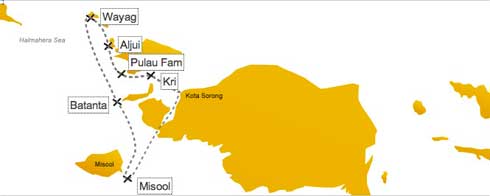
During the trips in West-Papua, the Amira visits the most beautiful dive sites of Raja Ampat.
From Sorong the trip takes you to the coral and macro paradise of the island of Misool. Dive sites
like Gorgonian Passage, Fiabacet and many more are a guaranteed to deliver colourful and memorable dives.
The second part of the trip leads to the island labyrinth of Wayag in the northern part of Raja Ampat where, in addition to the dives in fish rich waters, the spectacular scenery ensures interest.
The cruises come to a crowning conclusion at the famous dive sites of Cape Kri and Manta Point by Mansuar.
Notes
Additional fees for Raja Ampat: Port clearance & Harbour tax: USD 115,- National park fee & Local fee: USD 145,- Fuel surcharge: USD 175,-Euphoria
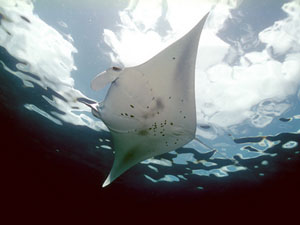 Raja Ampat
The Euphoria offers 12 day, 11 night cruises in Raja Ampat with up to 4 dives per day. Each safari covers the northern and central islands, including Mansouar, Penemu, Fam, Wayag, Waigeo, Batanta and many more small islands.
Beautiful coral reefs combined with a rich underwater life guarantees amazing dives: shools of fish (f.e. tunas, barracudas, horse mackerels), large reef fish (like napoleons, 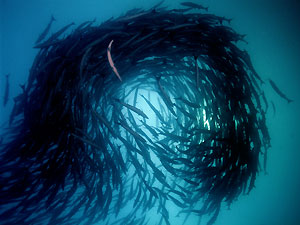 snappers, groupers, sloth bears) and manta rays.
Cenderawasih Bay
The whale shark is the biggest fish in the sea, which impresses and attracts divers with its charm and majesty. Eating only plankton and small fish, the whale shark is completely harmless to humans. Unfortunately its existence is in risk, due to humans’ activities and a low birth rate. These giants can live up to 100 years.
To find the whaleshark we sail to the Cenderawasih National Park, situated in the Cenderawasih Bay on the north side of Indonesian’s province West Papua. The 1,400,000 hectare park, founded in 1993, is the largest marine park in Indonesia.
The name “Cenderawasih” comes from the bird of paradise, which is a symbol of Papua.
The park is located 250 kilometres away from Manokwari and includes pristine coast and dozens of uninhabited islands. The closest villages are situated on bigger islands: Yap, Rumberpon, Roon and Mioswar.
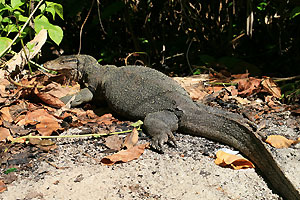
The jungle is inhabited by deers, wild pigs, casuariidae, monitor lizards and forest kangaroos. Papua is also a paradise for bird-watchers: one can see there 37 species of birds of paradise, white and black royal cockatoos, sea eagles and hornbills.
Wreck diving
The underwater world hides many wrecks from the times of II World War. Most of them are located in D’Ore Bay, nearby Manokwari.
The first part of Euphoria’s Cenderawasih trip leads to the heart of Cenderawasih Park, where the rocky islands are inhabited by people of Roon, descendants of former cannibals.
Another attraction will be a trip to the Yende village, where people still live without electricity, in huts made of bamboo, covered with the palm leaves.
The second part of the trip is a tour to the Auri Islands, 30 kilometres away from Roon. They are totally different: small, low, with white, endless beaches. Further south we sail to look for the whale sharks.
Itineraries
A typical Raja Ampat itinerary looks like this:
Day 1: Meet and greet at the airport in Sorong, embark The Euphoria, buy your Raja Ampat entrance fee (500 000Rp = 50 USD), dinner on board and departure.
Day 2: Diving: Sardine Reef, Middle Reef, Kri Island, Sunset Cape.
 Day 3: Diving: Hidden Reef, Manta Station, Mansuar’s West Cape, night diving: Home Reef, visit Suwandarek village on Mansuar Island.
Day 4: Diving: Manta Run, Manta Station, Strait of Gam; evening trip around Penemu Island and camp fire on the beach of one of the small islands.
 Day 5: Diving: 2 rock, South Penemu Strait, visit the spectacular Hidden Bay
Day 6: Diving: Lagoon, North Penemu, trip into Kawe Islands direction.
Day 7: Diving: Eagle Rock, West Kawe, reach the peak of Bala Bala Island with an impressive view over Raja Ampat Islands, sail to Wayag Islands crossing the Equator (From the South to the North), diving nearby to the monitoring station.
Day 8: Visit to Rocky Bay, hiking in the mountains, diving: Batu 5, Batu 4, Batu 3.
Day 9: Islands: Urania and Quoi, diving on the reefs around, exploration of the cave.
Day 10: Diving on the reef nearby Kawe Island, crossing the Equator (From the North to the South), reaching the Aljuwi Bay.
Day 11: Visit a pearl farm with the chance to buy some souvenirs, diving: Aljuwi, Woh Island and on the way back to Sorong.
Day 12: After breakfast transfer to the airport and departure.
A typical Cenderawasih itinerary goes like this:
 Day 1: Meet and greet at the airport in Manokwari, board the ship, buy a pass for the Marine Park Cenderawasih (around 700,000rp = 70 USD), dinner on board and depart.
Day 2: Mioswar Island, diving on the nearby reefs, a trip to the hot springs and bathe in the warm river.
 Day 3: Roon Island, diving: North Cape, Underwater Rocks, visiting the village Yende and Shallow Dive.
Day 4: Wasior waterfall, Aysemdami waterfall, diving: Selat Roon.
Day 5: Auri Islands, camping and campfire on the Kaka/Kaki Island.
 Day 6: Matas Island and the Isle of Kwom.
Day 7: Searching for whale sharks.
Day 8: Roon Island, camping and campfire.
Day 9: A lonely reef in the middle of the 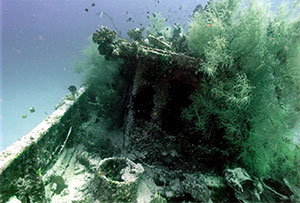 Cenderawasih Bay.
Day 10: Purup Island.
Day 11: Wreck diving in Manokwari.
Day 12: After breakfast transfer to the airport and departure from Manokwari.
Pearl
Pearl of Papua Itineraries
1. 7N8D - North - Raja Ampat
Potential Schedule for 8 days / 7 nights in Raja Ampat Islands
Day One: Sorong
When you arrive at Sorong Airport a member of the crew will be waiting for you in the arrival hall ready to escort you to the harbour where the tender boat will take you out to the Pearl of Papua. Board the ship where the friendly crew will greet you with a cold refreshing towel and drink. This will be followed by cabin allocation and boat orientation. Once all guests are on board, the Cruise Director will give you a presentation about the Pearl of Papua and diving recommendations. Depending on departure time they maybe an opportunity to have a check dive just outside Sorong Harbour. Lunch and dinner will be served during the sail out to Raja Ampat (08hrs)
Day Two: Dampier Strait
The first dive is a check dive and Mioskon Island is a great place to do this - a world class dive. Here the guests can get comfortable with their equipment, buoyancy and refresh some basic skills. The Dampier Strait area has some of the most action packed diving in Raja Ampat and guests can see fish, fish and more fish but it is also the area where the saying 'No Current = No Fish' originated from. There are many dive sites to choose from but Cape Kri, Chicken + Sardine Reef, Mikes Point and Mioskon are definitely on the schedule
Day Three: Penemu Islands
Fantastic examples of Raja Ampats diversity. The Penemu Islands are presently a new Marine Protected Area (WWF). We shall dive at Reef Bayanggan, Melissa's Garden which has probably the best complete coral coverage you will ever see and Kerunemo Adik. After your third dive we will take you on a tour of The Hidden Bay (includes a trek up Penemu Hill for the amazing views of The Hidden Bay)
Day Four: Kawe Islands and Aljui Bay
After your tour of The Hidden Bay we set of for a 12hr drive up to the north of Raja Ampat and dive around the Kawe Islands and Aljui Bay. The entire Aljui Bay has been leased out by Atlas Sea Pearls and the dive sites include White Arrow, Tear Drop Corner and the infamous Cendana Pearl Farm Jetty. It is also possible to tour the pearl farm
Day Five: Yanggefo
After a 12hr drive back down to the south / middle of Raja Ampat we will dive at Yanggefo. Here we will dive Mayhem, Citrus Ridge and Gam Ridge followed by some snorkelling in the mangroves looking for the Archer Fish and seeing the unique corals that grow in front of the mangroves (normally corals grow 100m plus away from the mangroves), followed by a night dive at either of the ridges, we will overnight in the mangroves
Day Six: Arborek
Our morning dives are at Manta Sandy where there is a manta ray cleaning station and we see both Black / White and the all Black Manta Rays come to be cleaned. This famous site now has a line of dead coral where guests line up and watch the show. Third dive is a beautiful coral / fish dive close to Arborek Island where guests can also have a sun set walk on the beach before the fourth / night dive at the village jetty
Day Seven: Dampier Strait
Finishing off your great trip with two shallow dives around Sardine and Chicken Reef before returning to Sorong
Day Eight: Sorong
After breakfast the Cruise Director will escort the guests to either the airport / hotel and will assist with checking in. Sorry to say that your Pearl of Papua Raja Ampat trip has come to an end and we look forward to welcoming you onboard again.
2. 7N8D - South to North - Raja Ampat
Potential Schedule for 8 days/7 nights in Raja Ampat Islands
Day One: Sorong
When you arrive at Sorong Airport our crew will be waiting for you in the arrival hall, after collecting your luggage we will escort you to the harbour where our tender boats will take you out to the Pearl of Papua and our friendly crew will greet you with a cold refreshing towel and drink. This will be followed by cabin allocation and boat orientation. When all guests are on board the Cruise Director will give you a presentation about the Pearl of Papua and diving recommendations. Depending on departure time there may be an opportunity to have a check dive just outside Sorong Harbour. Lunch and dinner will be served during the sail out to South Raja Ampat (12hrs)
Day Two, Three, Four, (Misool Islands)
One of the many fascinating diversities of Raja Ampat, with some of the most amazing land scapes imaginable, deep mangroves to ravines and canyons, the Misool Islands have been shaped by the powerful forces of nature, underwater the vibrant variety of colour of the hard corals / soft corals / fish species is wonderful. Diving at the Boo Windows, Nudi Rock, Goa Farundi and Magic Mountain (Reef Bayangan) are just some of the awesome sites you can see
Day Five: Penemu Islands
More great examples of Raja Ampats diversity. The Penemu Islands very recently became an Marine Protected Area and we spend most of our time here in the M.P.A. Melissa's Garden has probably the best complete coral coverage you will ever see and no visit to these islands is complete without seeing the Hidden Bay
Day Six: Arborek
The morning dives are at Manta Sandy where we regularly see the Black / White and the all Black Manta Rays come to cleaned. This famous site now has a line of dead coral where guests line up and watch the show. Third dive is a beautiful coral / fish dive close to Arborek Island where guests can also have a sun set walk on the beach before the fourth / night dive at the village jetty
Day Seven: Dampier Strait
Finishing off your great trip with two shallow dives in the Dampier Strait which has some great action packed fish dives, like Cape Kri and Blue Magic. After your busy diving schedule has come to a sad end we will have a lazy afternoon on Pulau Pasir (Sand Island) before returning to Sorong
Day Eight: Sorong
After breakfast the Cruise Director will escort the guests to either the airport / hotel and will assist with checking in. Sorry to say that your Pearl of Papua Raja Ampat trip has come to an end and we look forward to welcoming you on board again.
3. 10N11D - South to North - Raja Ampat
Potential Schedule for 11 days/10 nights in Raja Ampat Islands
Day One: Sorong
When you arrive at Sorong Airport our crew will be waiting for you in the arrival hall, after collecting your luggage we will escort you to the harbour where our tender boats will take you out to the Pearl of Papua and our friendly crew will greet you with a cold refreshing towel and drink. This will be followed by cabin allocation and boat orientation. When all guests are on board the Cruise Director will give you a presentation about the Pearl of Papua and diving recommendations. Depending on departure time they maybe an opportunity to have a check dive just outside Sorong Harbour. Lunch and dinner will be served during the sail out to South Raja Ampat (12hrs)
Day Two, Three, Four, Five: Misool
One of the many fascinating diversities of Raja Ampat, with some of the most amazing land scapes imaginable, deep mangroves to ravines and canyons, the Misool Islands have been shaped by the powerful forces of nature, underwater the vibrant variety of colour of the hard corals / soft corals / fish species is wonderful. Diving at the Boo Windows, Nudi Rock, Goa Farundi and Magic Mountain (Reef Bayangan) are just some of the awesome sites you can see
Day Six: Fam and Penemu
More great examples of Raja Ampats diversity. The Penemu Islands very recently became an Marine Protected Area and we spend most of our time here in the M.P.A. Melissa's Garden has probably the best complete coral coverage you will ever see and no visit to these islands is complete without seeing the Hidden Bay
Day Seven: Wayag (Northern Hemisphere)
After your tour of The Hidden Bay we set of for a 12hr drive up to the north of Raja Ampat and dive around the Kawe Islands and Aljui Bay. The entire Aljui Bay has been leased out by Atlas Sea Pearls and the dive sites include White Arrow, Tear Drop Corner and the infamous Cendana Pearl Farm Jetty. It is also possible to tour the pearl farm
Day Eight: Yanggefo
After a 12hr drive back down to the south / middle of Raja Ampat we will dive at Yanggefo. Here we will dive Mayhem, Citrus Ridge and Gam Ridge followed by some snorkelling in the mangroves looking for the Archer Fish and seeing the unique corals that grow in front of the mangroves (normally corals grow 100m plus away from the mangroves), followed by a night dive at either of the ridges, we will overnight in the mangroves
Day Nine: Arborek
The morning dives are at Manta Sandy where we regularly see the Black / White and the all Black Manta Rays come to cleaned. This famous site now has a line of dead coral where guests line up and watch the show. Third dive is a beautiful coral / fish dive close to Arborek Island where guests can also have a sun set walk on the beach before the fourth / night dive at the village jetty
Day Ten: Dampier Strait
Finishing off your great trip with two shallow dives in the Dampier Strait which has some great action packed fish dives, like Cape Kri and Blue Magic. After your busy diving schedule has come to a sad end we will have a lazy afternoon on Pulau Pasir (Sand Island) before returning to Sorong
Day Eleven: Sorong
After breakfast the Cruise Director will escort the guests to either the airport / hotel and will assist with checking in. Sorry to say that your Pearl of Papua Raja Ampat trip has come to an end and we look forward to welcoming you onboard again.
Notes:
- Cruising itineraries and daily programs are subject to change due to weather / sea conditions and dive site / anchorage availability. Every effort will be made to complete the program as planned and the Cruise Director will update the guests at meal times
- We strongly advise you to bring your own dive equipment for comfort and familiarisation
- The Pearl of Papua has a strict NO GLOVE POLICY
The Amira
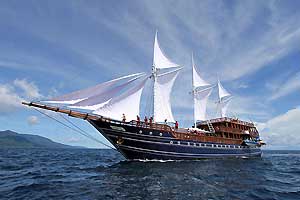 Amira was built with locally grown timber by indigenous craftsmen using ancient Pinisi boat building traditions. She is equipped with a state of the art navigation system, security and rescue equipment and technology.
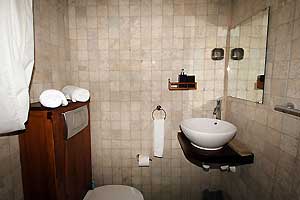
With a length of 52 metres Amira offers 8 comfortable double cabins and two single cabins, all equipped with personal showers 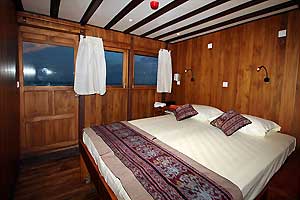 and toilets and natural lighting. There is a cozy restaurant, a romantic lounge area and a huge sun deck and… and… and…a dream boat, our dive boat.
The dive area is a generously designed space to gear up with a fixed site for each diver, several rinse tanks, plenty of surface space and a large 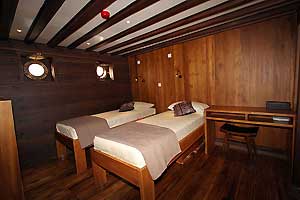 camera room. All in all an ideal base camp for the dive excursions in Komodo, Raja Ampat and Banda.
Cabins
For a total of 18 guests, there are five double cabins (14m²) and two single cabins (8m²) available on the upper deck and three double cabins on the lower deck (13m²). All cabins are equipped with air conditioning, hot showers and toilets.
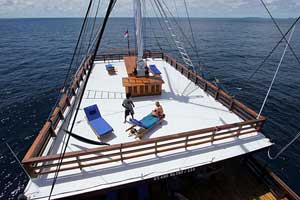 For full charter service it is possible to comfortably accommodate three people per cabin up to a maximum of 24 guests.
Sun Deck
A large sundeck with 120 m² offers an ideal place to sunbathe or relax on sunny days.
Upper Deck
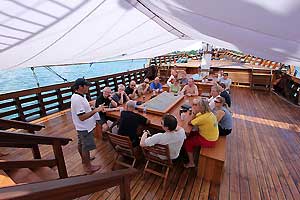 In addition to the guest cabins, the wheelhouse, the owners' cabin and a small office are also situated on the upper deck.
Main Deck
On the main deck a comfortable, covered lounge invites you to relax between dives.
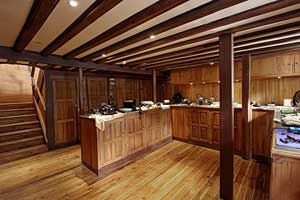
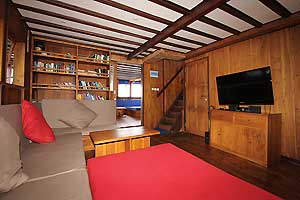 On this deck you will find the restaurant seating 20 guests (26 during a full charter), as well as a comfortable TV and lounge area.
In the computer room, computers and DVD/CD burners are available for you to edit and save your daily photographs.
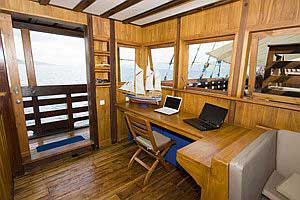 The large fore deck is equipped with deck chairs and a shade canopy for hot days.
Lower Deck
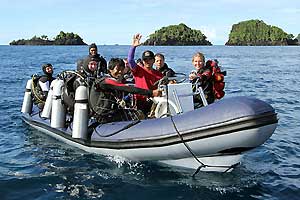
The dive deck offers space for maximum 24 guests and a maximum of 6 dive guides. There are also storage areas for cameras, dive lamps etc. and several rinse tanks.
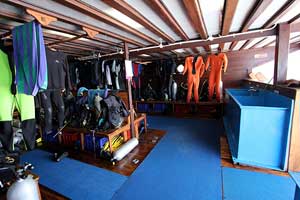 The diving equipment stays mounted on the tank during the whole trip and the tanks are filled in situ with air or Nitrox.
In the camera room are a 9m long workbench as well as downloading possibilities and further storage areas for guests to use.
Safety
 During the planning, construction and operation of the boat, every effort was made to attain high security standards. For example, there are emergency exits on the cabin deck, fire detectors all over the boat and large number of fire extinguishers. Of course, there are also an adequate number of personal flotation devices and lifebuoys.
 To diminish possible interruptions or emergencies, all major technical equipment is available in duplicate on board. Such equipment include motor, generator, anchor vice, dinghies, compressor and water maker for drinking water preparation.
 Amira is the first boat in Indonesia equipped with the electronic emergency and location system ENOS, a particularly valuable safety measure when diving in strong currents. On board there is extensive and highly specialised medical emergency equipment available and all crew members are trained in appropriate safety procedures.
The Arenui
The Arenui is a traditional-style Pinisi sailing schooner that has been kitted out to feel like a truly classy, boutique hotel. Featuring plenty of wood and fine decorative detail, this boat is for the diver who likes to sink into comfort at the end of the diving day.
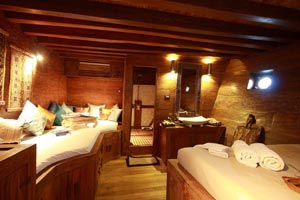 Accommodation
The Arenui has been designed to host a maximum of 16 passengers in cabins that are exceptionally spacious (starting from 17 m²) and luxuriously furnished.
The cabins' individual themes and styles are inspired by handicrafts from each of the Indonesian provinces. Each has a private en-suite bathroom and individual air conditioning, a king-size bed or roomy singles, and a distinct lounge area to guarantee maximum comfort and ensure that guests never feel crowded.
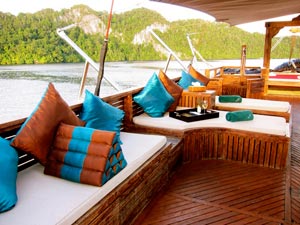 Services and facilities
The Arenui also offers other amenities normally only found on land, such as a full range of massage and spa treatments, a computer for looking through your photos of the day's dives, an internet connection and an extensive selection of books and movies in our library/entertainment centre.
The Restaurant & Lounge
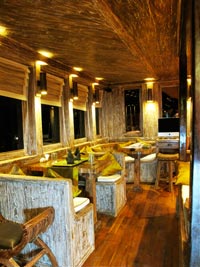 On the Arenui, the food is always plentiful and fresh. Local seafood is, of course, a specialty, but imported meats, organic fruits and vegetables and other special ingredients are flown in as well… all of which allow the Arenui's chefs to create tasty and inventive dishes. Dining is à la carte, rather than buffet style, and special dietary needs can be accommodated. Guests have the option of dining either in the comfortable restaurant cabin or al fresco under the canopy on the sky deck, where you will also find deck chairs and sun loungers to allow you to just lie back and soak up some rays or to sip a cocktail while watching the sun descend below the horizon across the water.
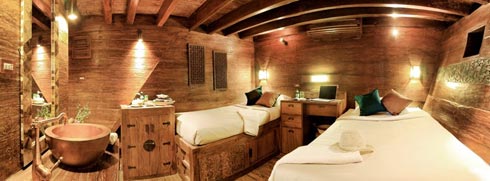
Cabins
Garuda
Lower deck, 20 squared meters, 2 single beds, spacious desk, en-suite bathroom, 3 portholes and individual air conditioning, minibar
Suitable for individuals (2 single beds)
Toraja
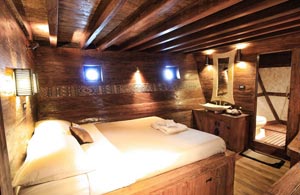 Lower deck, 20 squared meters, king-size bed, relax/sofa area, en-suite bathroom, 3 portholes, individual air conditioning, minibar
Suitable for couples (king-size bed), individuals and families (a very big sofa can be considered as additional single bed)
Dayak
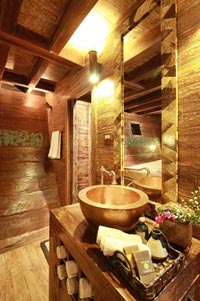 Lower deck, 21 squared meters, king-size bed, relax/sofa area, en-suite bathroom, 3 portholes, individual air conditioning, minibar
Suitable for couples (1 king-size bed), individuals and families (a very big sofa can be considered as additional single bed)
Legong
Lower deck, 20 squared meters, king-size bed, relax/sofa area, en-suite bathroom, 3 portholes, individual air conditioning, minibar
Suitable for couples (king-size bed) and individuals and families (a single bed/sofa can be used as third bed)
Barong
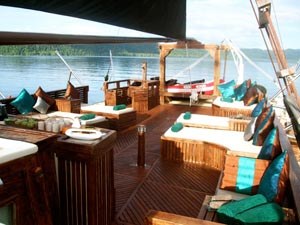 Upper deck, 19 squared meters, 2 single beds, spacious desk, en-suite bathroom, 2 big windows, individual air conditioning, minibar
Suitable for individuals (2 single beds)
Ganesh
Upper deck, 19 squared meters, 2 single beds, spacious desk, en-suite bathroom, 2 big windows, individual air conditioning, minibar Suitable for individuals (2 single beds)
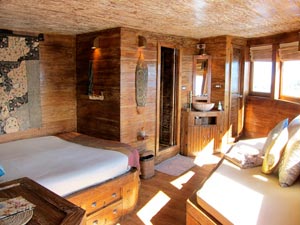 Shinta
"Sea-view" master cabin, upper deck, 20 squared meters, king size bed, sofa/relax area, en-suite bathroom, 7 big windows, private balcony, individual air conditioning, minibar
Suitable for couples (king-size bed) and persons looking for a very special atmosphere
Rama
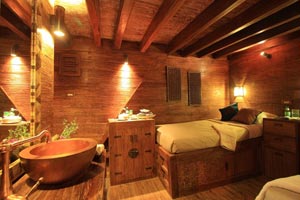 "Sea-view" master cabin, upper deck, 20 squared meters, king size bed, sofa/relax area, en-suite bathroom, 7 big windows, private balcony, individual air conditioning, minibar Suitable for couples (king-size bed) and persons looking for a very special atmosphere
The Aurora
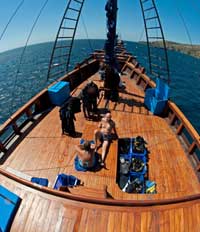 The MSY Aurora is a twin mast motor sailor, constructed from teak in the traditional “Pinisi” style, and designed for a demanding clientele of diver looking for a high standard of comfort.
Utilising modern and environmentally friendly operating principles, the Aurora offers scuba safaris to some of the World's richest marine environment all around Indonesia.
The construction of Aurora began in December 2007 at a traditional shipyard in South Sulawesi, and she was launched in the summer of 2009.
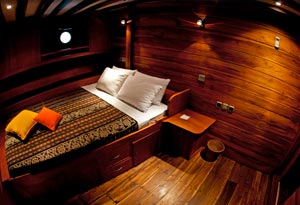 All cabins have individually controlled AC, en-suite bathroom and shower. There is a saloon/restaurant with library, computer room/study room with PC, DVD, video, photo, recharging batteries, and a spacious sun deck.
Technical data
- Overall length: 42 m
- Width: 9 m
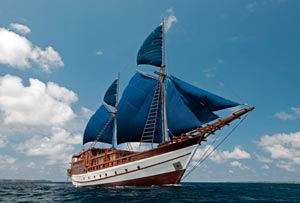 Tonnage: 75 tons
- Sailing surface: 300 m2
- Power: 1 engine: Nissan 420 HP, cruising speed: 8-10 knots.
- Accomodation: 7 double cabins of which 3 dispose over a third bed.
- All cabins have individually controlled AC, ensuite bathroom and shower.
- Stairs on both sides lead to the diving tenders
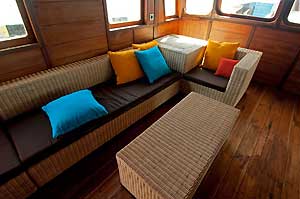 Saloon/restaurant with library, computer room/study room with PC, DVD, video, photo, recharging batteries
- Open sitting corner at bow; the roof of the restaurant is a very spacious sun deck.
Equipment on board
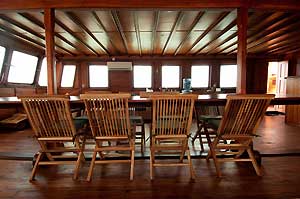 GPS, radio, sat-phone, echo sounder
- 2 generators for 220 V in each cabin (2-pole plug, without the third earth pole – like in continental Europe)
- 2 compressors for air, 1 compressor Nitrox
- 3 tenders for each 8 persons
- water maker 6000 ltr/ day
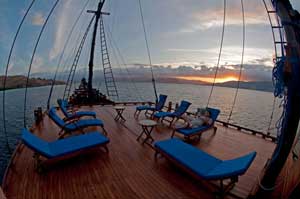 Safety devices
- First Aid kits
- emergency oxygen
- manual fire extinguishers
- 406 EPIRB – Emergency Position Indicating Radio Beacon
- life vests for all passengers including crew members
- 2 life rafts
- Sailing surface: 300 m2
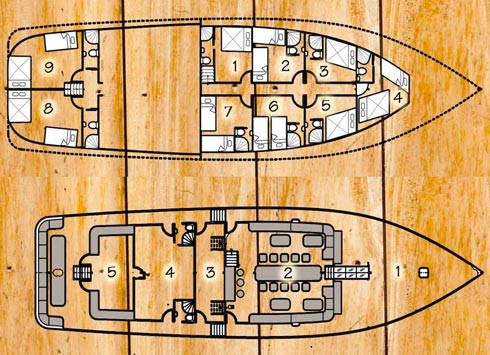
Top: Cabins
Bottom:
1- foredeck, preparation area for scuba diving
2- Restaurant/bar
3- Captain’s bridge
4- Diving equipment/compressors/ laboratory
5- Lounge/photo/video area
The Damai
The MSY Damai is purpose-designed and for cruising and diving Indonesian waters, 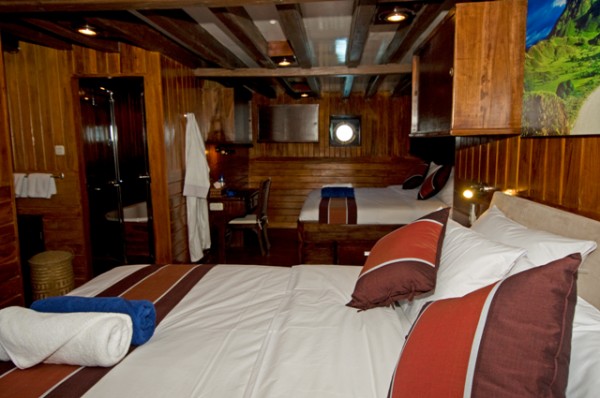 with passenger well-being always her top priority. Equipped with the latest navigation, communication and safety equipment, our vessel sets a new standard for safety as well as comfort, service and passenger amenities.
Of course even the best ship is only as good as her crew, and this is another area where Dive Damai shines. Every trip is managed by a seasoned western cruise director, complimented by our experienced and ever-helpful Indonesian crew, all of whom are dedicated to making your diving holiday the trip of a lifetime.
The Msy Damai was built in Bira, 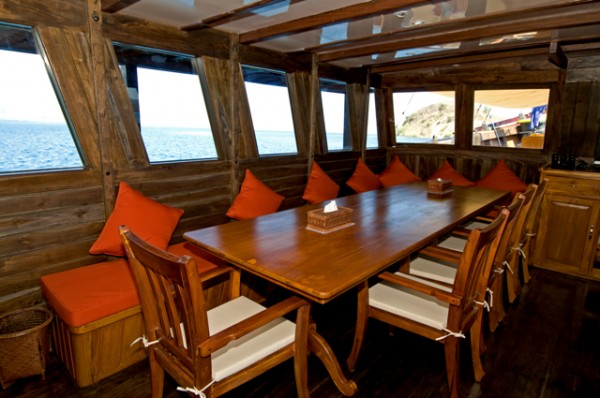 south Sulawesi, by Pak hadji Baso, the most prestigious builder in the area, combining tradtion with new techniques, as we have done with the scarf joints, floors or decks.
The MSY Damai is being designed to offer that personal service, that only a boutique liveaboard dedicated to small groups can provide.
- 33mts of lenght x 8 mts wide
- Mitsubishi M10/20 520HP engine to assure a cruising speed over 8 Knots generators: Mitshubishi 40Kwa, Mitshubishi 25Kwa and Isuzu 20Kwa
- 4 cabins well over 30 sq. meters each, coming with either queen or king sized beds,
 separated ensuite toiletts and showers/bath tubs
 - Individual rinse tank at the diving station
- Individual separated space in the working camera area, with Integrated 110v and 220v charging station for each customer.
- Max of 3-1 ratio
- 2 dedicated dive tenders
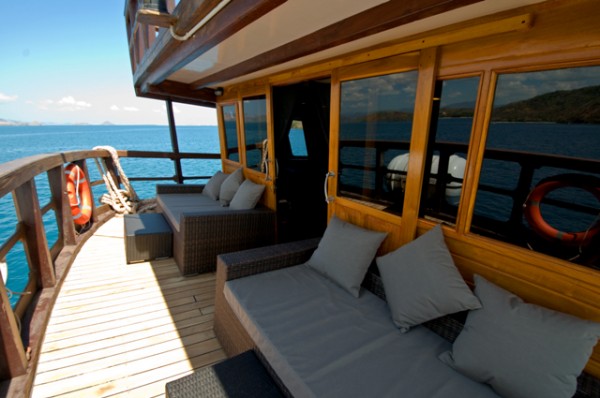
- 3 relaxing areas: lounge, sun and shade decks
- Unlimited diving
- All day open menu to eat at your own time
- Spa with professional masseuse
Boat Specifications:
Tanks
Fuel tanks - 4 units @ 5000 ltrs capacity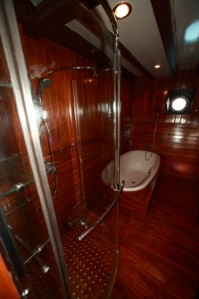
Fresh water tank - 1 unit @ 10.000 ltr capacity
Fuel daily tank - 1 unit @ 1.000 ltr capacity
Gray tank - 1 unit @ 600 ltr capacity
Black tank - 1 unit @ 600 ltr capacity
Navigation Equipments
Echo sounder & GPS plotter - GP 1650F
Radar FURUNO (36NM) - F1832
Standard Compass - Toyo Keiki
HV Radio - Furuno M 710
VHF Radio -2 units - Furuno M 304
Electronic Chart - Maxi (ver 10.02)
Safety Equipments
Life Raft (Capacity 20 persons) - 3 unit
Life Jacket - 35 unit
Throwing line Apparatus - 1 set
Pyrotechnics - 2 set
EPIRB - 1 unit
Life Ring - 8 unit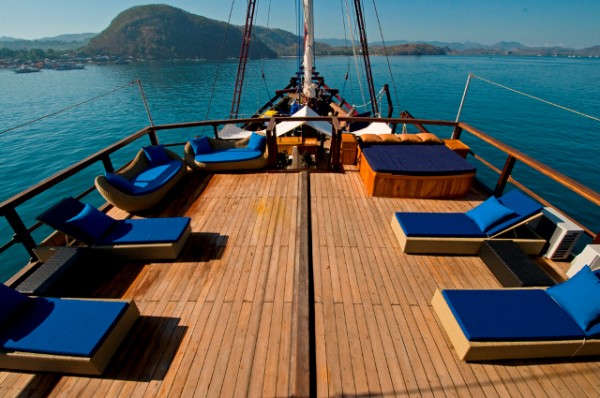
MOB beacon. - 2 unit
Fire Fighting Equipments
Fire man out Fit with breathing apparatus. - 1 unit
CO2 portable (6Kg) - 6 unit
CO2 portable (4Kg) - 2 unit
Foam portable (9Kg) - 4 unit
Bompet (foam automatic applicator) - 7 unit
Fix Hydrant with hose and nozzle - 2 unit
MSY Damai offers trips to Bali, Komodo, Triton Bay, Raja Ampat, Derawan, and Banda Sea
The Euphoria
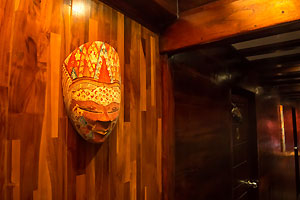 The KLM Euphoria is a luxury diving vessel completed in 2012, currently the youngest boat in the waters of Indonesia. This ship is built in the style of a traditional South Sulawesi Phinisi, handcrafted from the noblest species of tropical trees such as Teak, Iron wood and Merbau; modernly equipped and comfortably furnished.
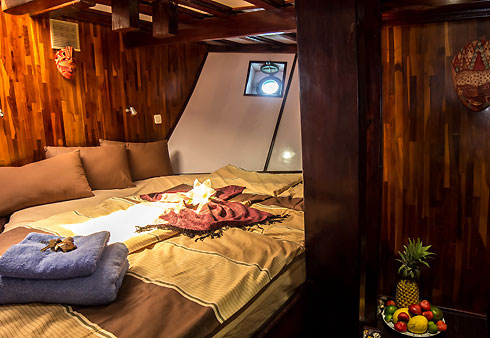
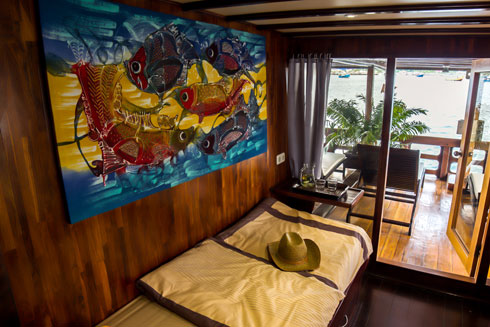
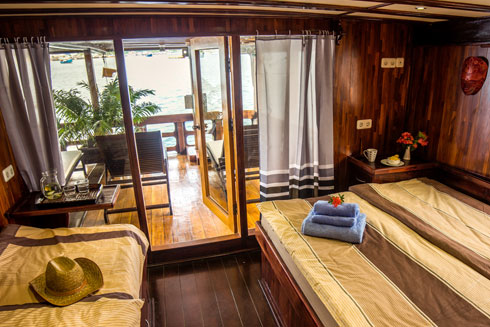
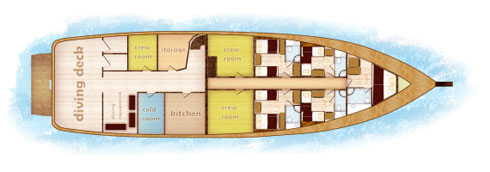
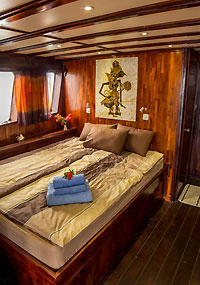 Each of the 9 cabins has a private bathroom, central air-conditioning, hot water shower, wardrobe, and TV. Two of the cabins on the upper deck are of higher standard (VIP). These VIP cabins are very spacious and bright with large window, a balcony, one double bed and one single.
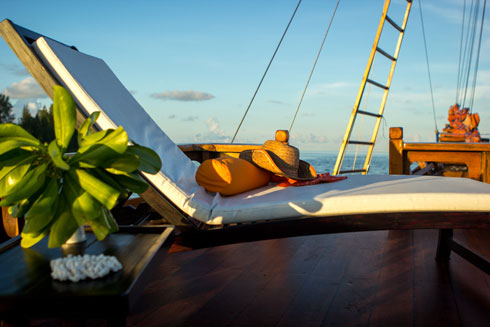
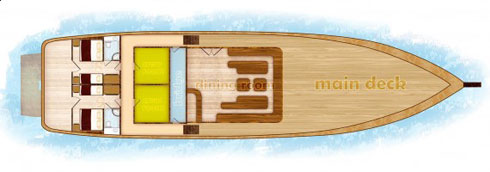
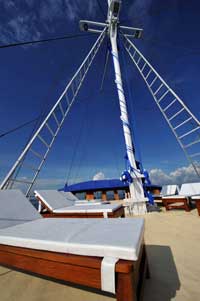
Euphoria’s spacious dining room and bar are located in the prow of the ship and you will find a cleverly designed sun-deck on the top level, equipped with sun-chairs and sun-beds.
The KLM Euphoria accommodates up to 16 guests on each trip, ensuring abundant space for all guests.


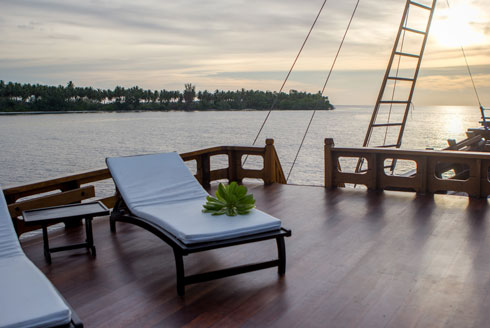
Lower Deck
Upper Deck
Sun Deck

The Indo Siren
 The 40 metre SY Indo Siren is one of the newest members of the Siren fleet of dive liveaboards, completed in the spring of 2011.
Built on the Indonesian Island of Sulawesi, the Indo Siren is a traditional “gaft rigged Phinisi” handcrafted from ironwood and teak. One of the most beautiful liveaboards in Indonesian waters, she was built by divers for divers such that almost every diver's need has been thought of and implemented.
The cabins offer flexibility and can be used as twins or double bedded rooms. The dining area is very spacious offering a great setting for all your meals.
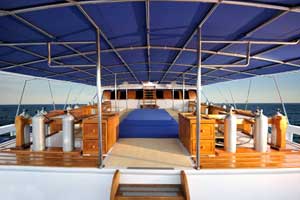 The dive deck is spacious and comfortable with designated areas for charging and preparation of cameras and video equipment. The S/Y Indo Siren sets out to be the pros choice for underwater photography and videography.
The S/Y Indo Siren accommodates up to 16 guests on each trip, ensuring abundant space for all.
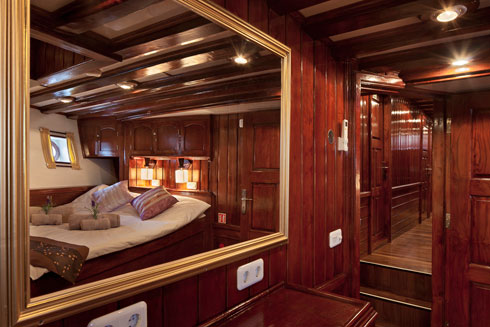
Features of the S/Y Indo Siren include:
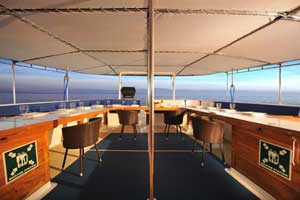 7 sails
- An expansive leisure deck area
- A spacious air-conditioned saloon with cocktail bar, 42 inch flatscreen & computer server supporting the inter-cabin network
- covered outdoor dining area
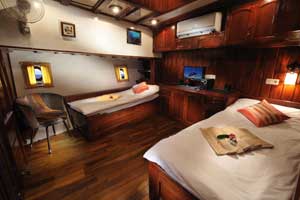 8 large air-conditioned cabins each with their own personal computer, audio-visual entertainment system and ensuite bathrooms with hot water. All rooms are lavished with luxury extra’s including bathrobes, hair dryers, towels, individually controlled mood lighting and individual controls for your air-conditioning unit.
- Laundry Service
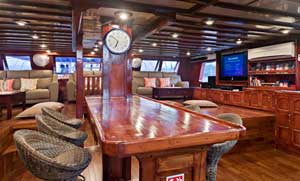 Massage Service
- Yacht Boutique, which will make available to customers Worldwide Dive and Sail merchandise, including towels, hats, log books, t-shirts, shorts and lighters just to name a few items
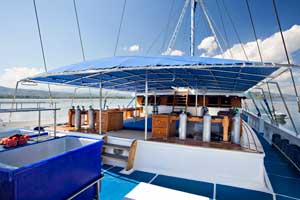 Enriched Air Nitrox is free for all certified Nirox divers. If you are not a certified Nitrox diver all our instructors can certainly teach you the Enriched Air Specialty
- 2 high-powered Zodiacs accompany the S/Y Indo Siren
- Kayaks
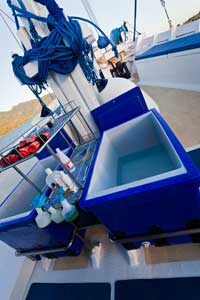 Special features for Underwater Photographers & Videographers include:
- Each cabin is fitted with an individual computer and multiple power sources to facilitate the needs of digital photography. The computer features high end specifications and 20” high definition flatscreens, which are integrated with the yachts network server in the saloon.
- Workstations for the preparation and maintenance of cameras including prep and storage areas
- Large rinse tanks with fresh water solely for cameras and videos.
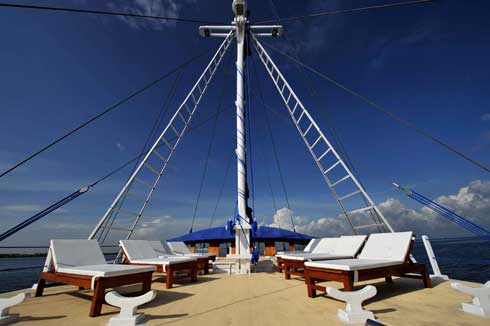
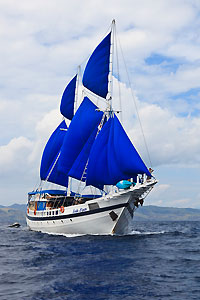 S/Y Indo Siren - Yacht Safety:
The S/Y Indo Siren has been designed and constructed based upon Lloyds Standards, the leading international body of maritime safety standards. The crew has been specially trained in all aspects of safety, emergency and evacuation procedures.
The S/Y Indo Siren is equipped with the latest safety features including Life Rafts, Life Jackets, Fire Extinguishers, Smoke Alarms, Emergency Long Distance Radios, and Satellite Phones.
The Mermaid I
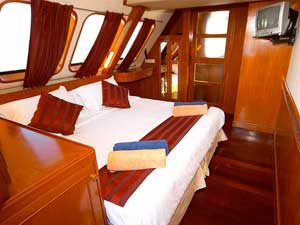 M/V Mermaid I is a 28 metre, twin-engined steel motor yacht. She comfortably holds 15 guests in 1 Master State Room (king bed), 1 Single and 4 Deluxe Cabins (double or twin beds) and 2 Budget Cabins (double/twin beds) below deck.
The master, single and deluxe cabins have ensuite bathrooms, refrigerator and panoramic sea view windows. The budget cabins are below decks with ensuite bathroom and refrigerator. All cabins have TV and DVD access, bathrobes and toiletries and loads of fluffy towels.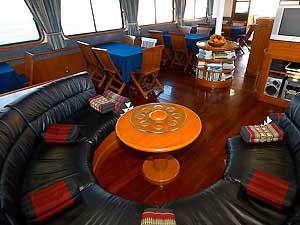
The large, purpose-built dive deck and wide stern dive platform with two exit ladders and fresh water showers are perfect for diving. 4 camera rinse tanks ensure your valuable equipment is well looked after.
Thai and western meals are served in the Sawasdee Restaurant, equipped with large windows to enjoy the views. After meals, you may relax in the saloon, equipped with 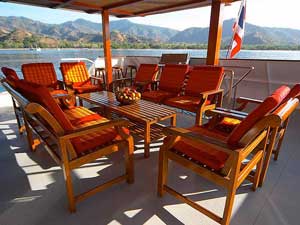 TV/DVD and music center, and an extensive library and full range of marine life books.
There are two outside decks, one shaded with outside seating and one sundeck with sunshade and cushioned sun beds. NITROX is available on every cruise.
Boat Information
- Name : Mermaid I
- Destination : Indonesia
- Seasons : June to October
- Capacity : 15 guests (max no. guests)
About the cabins
-
Cabin Facilities Rooms: 3 double beds 4 twin sharing, 1 single with private bathroom, Showers & toilets, Hot Water, TV, video and stereo.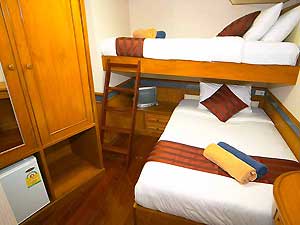
- Ele ctricity : 220V
- Sockets:
Technical Data
-
Length x Beam : 28 m / 94 feet,7 m / 21 feet.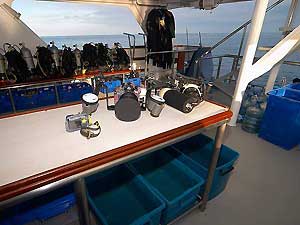
- Engines : 2x 450 HP
- Max speed : 12 knots
- Cruising speed : 9.5 knots
- Navigation equipment : GPS and radar for safety and ease of navigation.
- Communications equipment : VHF and SSB radios, a satellite phone, plus mobile telephone communications equipment.
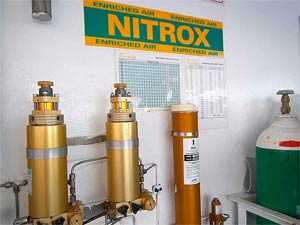 Fuel capacity : 18,000 Litres
- Fresh water capacity : 20,000 Litres
Further Information
- Dive Entry : platform or dinghy
- Life jackets : yes
- Life rafts : Yes
- Boat Crew :
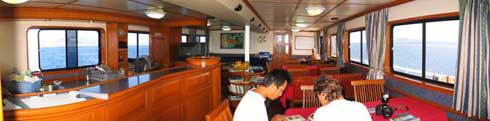
New:
1. Membrane System
Filling at 600 litres a minute equals fast turn arounds and unlimited nitrox available for all divers - no matter your destination or tank size - 12 litres or 15 litres - your choice!
2. More Camera Tables!
The membrane system means lots of extra deck space so more good news - 2 extra camera tables have been added and fresh water rinse containers... masses of room for all photographers on board. Plus added shelving for guest's to keep their small items close to hand on the deck...
3. Warm deck towels
Towels straight out of the dryer after each dive - just heaven!
4. Kayaks
For those who want to relax on the quiet waterways around Komodo and Burma, Mermaid now has some kayaks on board for those with a spirit of adventure.
5. How do you like your eggs?
Cooked to your specification in the saloon and served piping hot - as one would expect from any 5 star service!
The Mermaid II
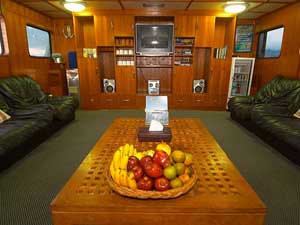 M/V Mermaid II is a 33 metre, double engine steel motor yacht. One of the most comfortable diver boats in Thailand, she easily accommodates 18 guests in 8 deluxe cabins and 2 guests in a budget cabin below deck. All deluxe cabins are on the main deck with large panoramic sea view windows.
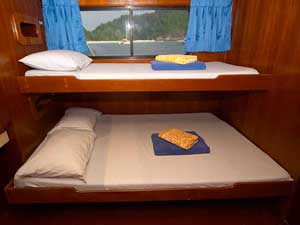 Each cabin has a double bed and single bunk (max pax 2 per cabin), air conditioning, ensuite bathrooms.
There is a wide stern dive platform with two exit ladders and fresh water showers. The dive deck is huge with plenty of room to gear up, individual boxes for your dive gear, camera table and loads of rinse tanks.
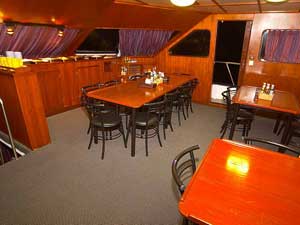 The dining room is located on the main deck where delicious buffet style Thai and western meals are served. The saloon is large and spacious with lounge suites and big windows, bar fridge, tea and coffee facilities, TV/DVD, music center, library and a full selection of marine life books.
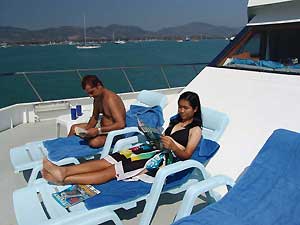 There are two outside decks – the shade covered party deck has a combination of lounge chairs and cushioned sun chairs, The sundeck, located in front of the wheelhouse has full sun and cushioned sun chairs. EANX NITROX is available on every cruise.
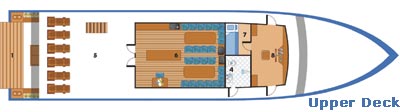
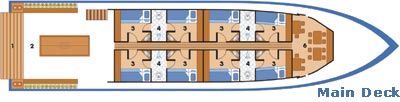
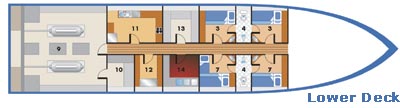
Boat Information
- Name : Mermaid II
- Destination : Thailand
- Seasons : October to May
- Capacity : 16 Persons (max no. guests)
About the cabins
- Cabin Facilities Room : - 8 Deluxe Cabins with one double and one single bed, 1 Budget twin cabin below deck, Hot water, Showers & toilets, ensuite with the deluxe, TV, video and stereo...the luxury adventure of a lifetime
- Electricity :220V
- Sockets:
Technical Data
- Length x Beam : 33 m / 104 feet,7 m / 21 feet.
- Engines : 2 x 450 hp
- Max speed : 12 knots
- Cruising speed : 9.5 knots
- Navigation equipment : GPS / Radar / depth sounder
- Communications equipment : VHF radio / SSB radio / / mobile telephone
- Fuel capacity/range : 18000 l
- Fresh water capacity : 20000 l
Further Information
- Dive Entry : Dive platform or dinghy
- Life jackets : Yes
- Life rafts : 2 20-pax SOLAS
- Boat Crew : Captain, 2 cooks, 1 engineer, cruise director, hostess, 2 deckhands.
The Ondina
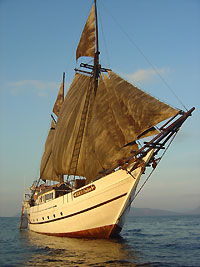 SMY Ondina is a traditional "Pinisi" style sailing schooner that has been beautifully restored to a high level of comfort and is fully equipped for dive safaris in the Kommodo National Park and other parts of Eastern Indonesia.
Expertly managed by charismatic Spaniard, Enrique, the SMY ONDINA sails the inner seas of Indonesia in search of "adventure" diving - exploring remote reefs that have been rarely dived before, if ever.
Itineraries are planned to find the best diving conditions available in each area. Embarkation points include 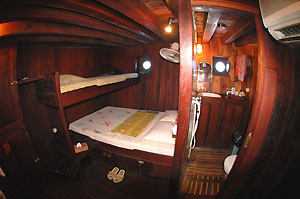 Bira or Kendari in Sulawesi, Maumere in Flores, Bima in Sumbawa or Sorong in West Papua, and the duration of the trips are designed to dovetailwith available flight connections. Cruises last from 8 to 14 days and will usually include opportunities to go ashore to discover some of the unique cultures and wildlife to be found in the Indonesian archipelago... including the extraordinary Komodo
 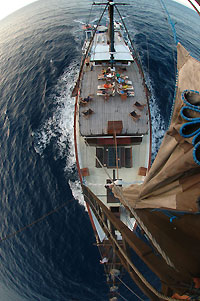 Dragon and Birds of Paradise.
The Ondina has gone all out to provide comfort for the select few that cruise with this fine traditional Pinisi Schooner. Her cabins are very well appointed, the dive deck is known as being one of the best, with special camera counters and staff that know how to take care of you and your gear. Nitrox and E6 processing available.
Full Boat Dive Charters
For groups, the Ondina can be chartered and itineraries can be personalised to suit your group needs, likings or skills. In this case, book early before she already has other commitments! Depending on where you wish to sail and 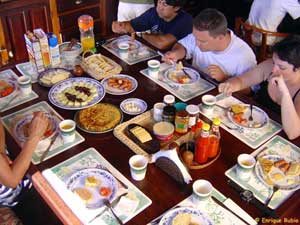 dive, there may be a charge for relocation to/from her original port of embarkation.
Non-Diving Charters
We can also arrange non-diving Cruises. The are many wonderful routes to be enjoyed in Indonesia without diving: Paradise beaches, fishing villages, island hopping, National Parks, traditional rituals and millenary ceremonies will make the best frame for a well deserved exotic holidays.
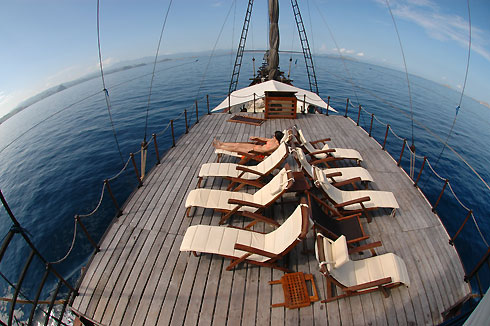
Boat Information
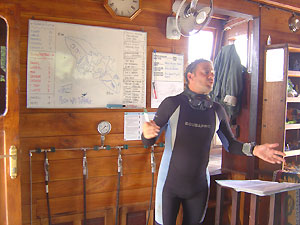 Name : SMY Ondina
- Destination : Indonesia
- Seasons : Year around
- Capacity : 16 maximum (max no. guests)
About the cabins
- Cabin Facilities Room : 8 double cabins with air conditioning and en suite bathrooms
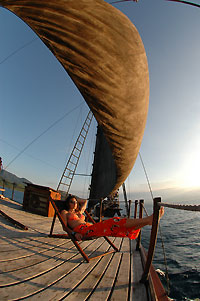 Electricity : 220V
- Sockets:
Technical Data
- Length x Beam : 32 x 8 metres
- Engines : 400Hp MAN Medium Duty
- Max speed :
- Cruising speed : 9 knots
- Navigation equipment : VHF Radio with Global Maritime Distress Signal System (GMDSS), SSB Radio, ICOM VHF hand sets
- Communications equipment : ERICSSON R190 Telephone: Access South East Asia Satellite and GSM
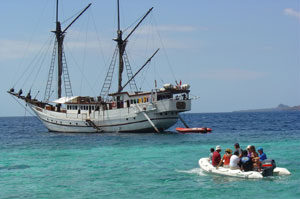 Fuel capacity/range : 12Tn
- Fresh water capacity : 10Tn
Further Information
- Dive Entry : 3 dinghies: 2 semirigid and 1 rigid with 40 and 25 HP YAMAHA engines
- Life jackets : 2 Solas Life Rafts for 30 pax
- Life rafts : Yes
- Boat Crew : Captain, Cruise Director, Dive Master, 3 sailors, engineer + assistant, cook, 2 service staff and a masseuse
The Pearl of Papua
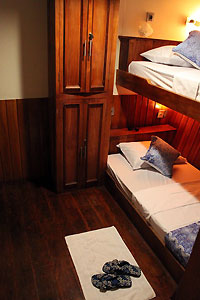 Pearl of Papua is one of Indonesia's newest, most practical and great-value Liveaboard vessels.
Built in 2010 with safety, practicality and comfort in mind, the Pearl of Papua is a new addition to the Indonesian fleet of traditional style, “pinisi” sailing boats offering liveaboard dive experiences in West Papua.
The 30 metre long, triple deck, wooden schooner was crafted by the highly respected and renowned boat builders of Tanah Beru in South Sulawesi. She is fitted with the latest marine technology and equipment ensuring international safety standards.
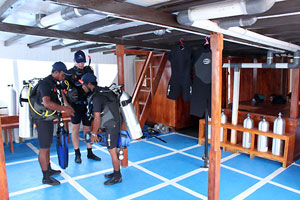 Specifically designed for liveaboard diving cruises, the Pearl of Papua provides a huge dedicated dive-deck with gear-up stations assigned for each diver throughout the cruise.
Accommodation
Facilities and amenities on board the Pearl of Papua are selected to provide the most comfort during your diving expeditions. The air conditioned cabins with en-suite bathrooms are 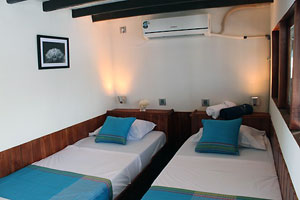 sleek yet cozy, a sanctuary to welcome you home after a long excursion undersea. The spacious decks provide enough room for everyone to laze privately and groups to mingle comfortably.
The Pearl of Papua offers 7 cabins:
- 2 Trevally Deluxe Cabins one with double bed and one with two single beds on the upper deck
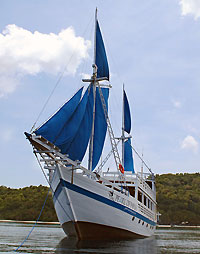 1 Manta Suite Cabin on the lower deck with one single bed and a double bed
- 4 Seahorse standard cabins with bunk beds on the lower deck.
- All cabins in lower deck have portholes and windows. The upper deck cabins each have a huge window.
Dining
A chef & stewards are also onboard to attend your dining & cabin needs around the clock. The galley offers a selection of Indonesian, pan-Asian and Western cuisine.
Dive Deck
Pearl of Papua has a special aft diving deck area fitted out with 2 Bauer Compressors and 35 air tanks for storing diving and snorkelling gear. Nitrox is available onboard.
The Pearl of Papua offers liveaboard charters with departures all year round to the pristine RAJA AMPAT.
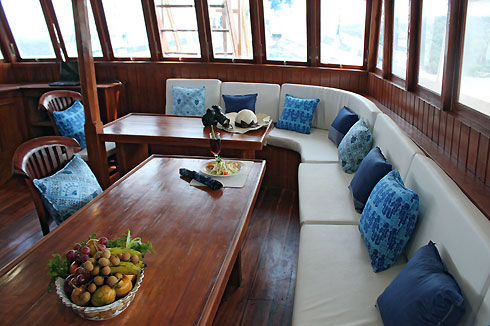
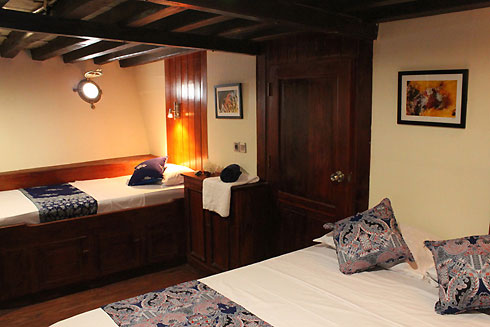
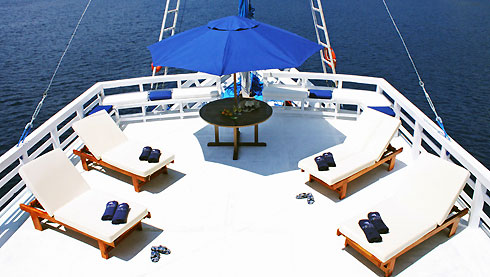
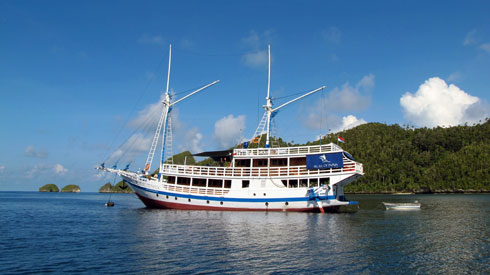
The Putiraja
 Originally a five-year-old rugged cargo ship, Putiraja is now a handsome dive liveaboard & leisure cruise vessel. Stretching 34m (110ft) long, she was built as a classic Indonesian wooden schooner (Pinisi). With a hull made of solid ironwood and interior walls erected from a mixture of exotic woods, she stands robust with everlasting elegance.
The spacious cabins are outfitted with private bathrooms and individually controlled air conditioning. With water supply from the sea processed by Reverse Osmosis units, she has a steady supply of pure fresh water. Solar heaters will provide warm bathing comforts, while the UV Sterilizer ensures that drinking water is clean and healthy for your consumption.
With comfort in mind, the Putiraja has been designed to accommodate lounging and relaxation of guests. Whether you want to sunbathe on the upper deck, socialize with other guests on the main deck, browse through fish books and movies in the library, or look over your photos and videos from the day's diving you can do it with comfort. Regardless of the activity, her fully equipped kitchen will provide mouth-watering and highly nutritious food and drinks, combining Indonesian and Western delicacies.

The diving facility utilizes quality equipment to produce safe and comfortable diving conditions.
Power for the ship's propulsion is provided by an eight cylinder Mercedes Benz diesel engine. Alternate power is provided by two main sails, two top sails, and three jib sails. All sails are made from the latest sail fabric, designed and manufactured in Annapolis, Maryland.
Cabins:
Retreat to a luxury cabin with warm exotic Indonesian wood decor and Papuan bark paintings at the end of your full diving day. Each cabin is equipped with air conditioning and en-suite international standards bathroom with hot showers. Sleep soundly on the comfortable anti-microbial, anti-bacterial, and dust-mite free latex mattresses with excellent spinal support covered in soft bed linens and duvet. Putiraja provides luxuriant towels and toiletries for the duration of your stay.
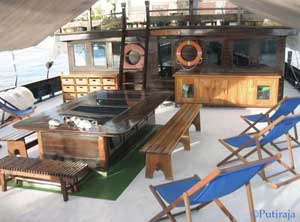
Putiraja's deluxe cabins are laid out in bunk style, with a double below and a twin above. Additionally, you can opt for the superior cabin on the upper deck with a queen bed and your own private balcony.
Common Areas:
Putiraja's spacious Main Deck is the center of many activities. From here you'll have a panorama of Raja Ampat waters where you can easily scout for schools of dolphins and the occasional acrobatic shows by pelagics. Shaded under a large canvas cover, the main deck boasts a gigantic table suitable for large group meals as well as games and other social activities. With an even more generous deck space, any guest could pull a lounge chair to the perimeter and have a quiet reading or nap time in the gentle breeze, while still be in the middle of all the liveliness.
Worship the tropical sun on the Upper Deck on Putiraja's comfortable chaise lounges. Enjoy an elevated view of the surrounding. The Upper Deck gets a lot of breeze all thoughout the day as Putiraja cruises on. Stare at the star encrusted sky at night while listening to the sounds of breaking waves. It's a great place for peaceful reflection.
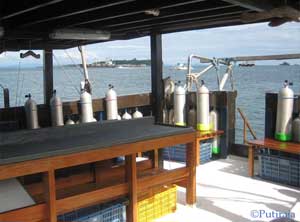
Putiraja's Scuba Area is equipped with a high standard tank & BCD station, benches, table, and water tanks to take care of your scuba gears. A set of steps with handrails connect the Scuba Area to a dinghy platform. Offering exclusive service means that you can entrust her trained crew with loading/unloading, rinsing, drying, and storing your scuba diving equipment. All you need to do is put on your own wetsuit.
Two showerheads with solar heated water are provided in the Scuba Area to allow guests to quickly rinse with fresh water after a dive.
Underwater Camera Area - Clean your camera equipment away from dust and wind in Putiraja's Camera Area. Store your extra gadgets in cabinets provided. The lipped table surface prevent camera parts from rolling off. There is also has a large flat screen TV that can be connected to your a/v.
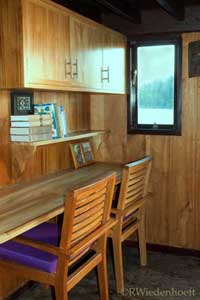 Technical Specifications:
- Guest capacity is 10 to 12 (depending on sleeping setup & trip specifics).
- Vessel's crew consists of 5 deckhands, 2 captains, 3 certified dive instructors.
- Main propulsion – 8 cyl. MB diesel with a 10 cyl MB diesel for back up.
- Secondary propulsion – Sails.
- Electrical power – twin 35KW Generators.
- Water source – pressurized reversed osmosis water system.
- Dive tanks – 40 units, BCDs & Regulators (minimal quantities).
- Dive tank fill-ups – Bauer and Colter Compressors.
- Navigation – Raymarine Radar & plotter system, forward & side sonar.
- On board oxygen & emergency support are available.
- Guests are requested to bring their own personal diving equipment. The boat furnishes tanks and weights, and have a limited supply of other items. Don't forget to bring two flashlights for night diving and a sausage tube for safety.
The ship's bridge is equipped with the latest navigation and communication technologies including Radar, Sonar, Chart plotter, GPS, etc.
The Putri Papua
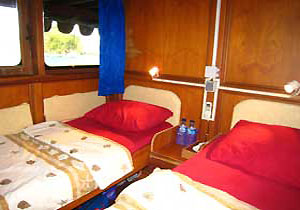 Putri Papua is a traditional, Indonesian style “pinisi” sailing schooner belonging to the same long established fleet that includes, Temukira and the Raja Ampat Explorer.
Facts • Services • Facilities
- 5 Air-Conditioned cabins for 9 persons with ensuite bathroom, shower, wash basin and toilet.
- Fan cooled lounge with dining seating for ten
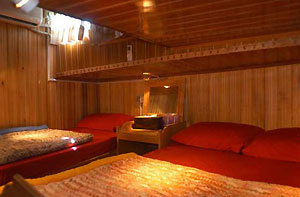 TV, CD / DVD Player
- Camera battery charging stations
- Camera work stations
- Satelite telephone
- Sun deck with awning
- On dive platform shower
- Bauer Compressor
- 10 gear up stations, 18 scuba tank
- European & Indonesian food
Putri Papua’s Technical Specifications
- MV Putri Papua Diagram and Layout
- Type : Wooden Schooner
- Length O.A : 26.16 meter
- Beam : 5.48 meter
- Draft : 2.52 meter
- Main Engine : 270 hp
- Speed : 8 - 9 knots
- Electricity : 220 V
- Tenders : 1 with 40 HP Engine
- Safety : 2 life rafts, 4 life buoys, 30 life jackets, 1 Cylinder of Emergency Oxygen, First Aid Kit
- Navigation : Furuno Radar 1932 K, Furuno Depth Sounder, FCV - 612, Furuno GPS, HF SSB Radio
- Flag : Indonesia
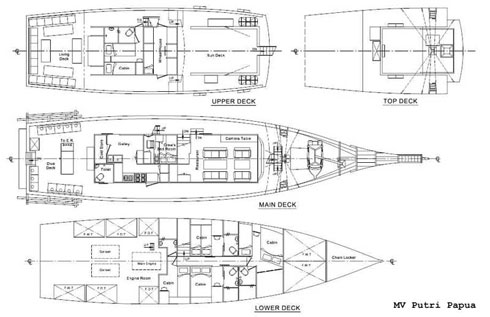
The Raja Ampat Agressor
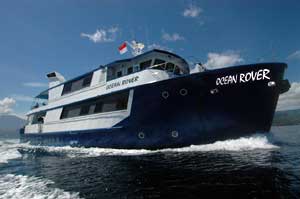 Formerly known as the Ocean Rover, The Raja Ampat Agressor is a purpose built, luxury, live aboard vessel built in Phuket by a team of divers looking for the perfect dive vessel. She was launched in August 2000 and then relocated to North Sulawesi in June 2008.
The Agressor was designed for comfortable and safe offshore diving. Her thick steel hull is 100 ft/30 m long and 26 ft/8 m wide. She is powered by three Hino 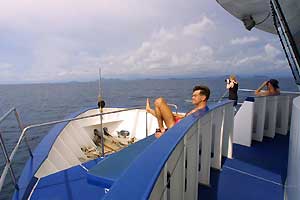 V10 420 Hp diesel engines, driving three propellers for extra safety. Her cruising speed is 10 knots and the top speed 12.5, allowing us to visit many far-flung dive sites in one single cruise.
Raja Ampat Agressor takes a maximum of sixteen passengers in eight cabins which are all located on the main and upper decks. There are no guest cabins below decks so there are 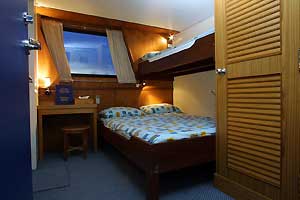 no loud annoying engine room noises! Six cabins feature large double beds with single upper berths and large panoramic windows. The two forward cabins feature wide upper and lower berths and have dual portholes. All cabins have private en-suite bathrooms, individually controlled AC and lots of storage space.
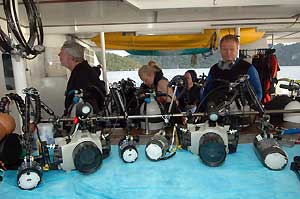 The huge dive-deck has several camera tables and rinse tanks. Care has been taken to ensure that photographers have safe places to put down their expensive cameras just before and after the dive. The Agressor’s unique feature is the “Whale-Deck”: The lower section of the dive deck which slopes down to the waterline allowing for optimum ease of diving operations. This “Whale-Deck” is where the
 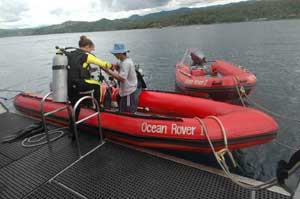 zodiacs are stored when the vessel is underway.
The spacious salon offers a comfortable dining and sitting arrangement, fully equipped entertainment centre and a camera charging area with 220/110 V connections. The interior has been kept light and airy and has a relaxed atmosphere. The salon has a fully stocked refreshments corner and our extensive marine life library. A 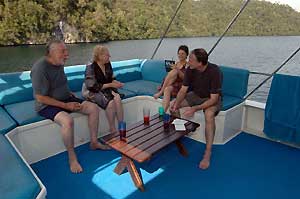 camera maintenance room is kept there as well.
The aft upper deck or sun-deck is partly shaded and is everyone’s favourite area for relaxing and socialising between dives. A second fully stocked refreshments corner is located there, including an ice maker and a second refrigerator. Passengers can sit around the large picnic style table or settle down on one of our comfortable  lounge chairs.
Raja Ampat Agressor's 16 passengers are cared for and pampered by 14 highly motivated and well trained crew members.
Raja Ampat Agressor's areas of operation are North Sulawesi, the Sangihe Archipelago and Raja Ampat in the East of Indonesia.
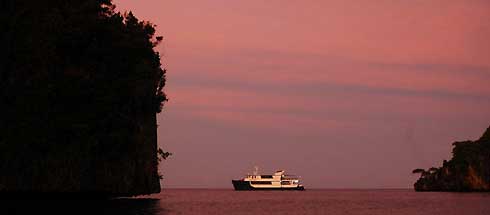
The Raja Ampat Explorer
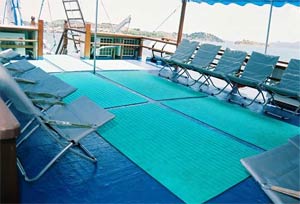 The Raja Ampat Explorer offers liveaboard dive cruises to the Raja Ampat islands of Indonesia's West Papua Province, Misool and Triton Bay on the Birdshead Peninsular, with occasional forays westwards to Alor, Flores, Wakatobi and Komodo.
The MV Raja Ampat Explorer is a traditional, 3-decked Pinisi Schooner, comfortably appointed with 7 double cabins, each with private en suite bathroom.
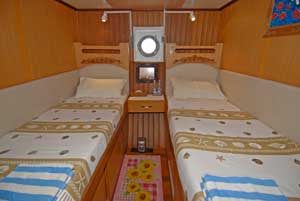 Facts • Services • Facilities
- 7 Air-Conditioned cabins for 14 persons with ensuite bathroom, hot shower, wash basin and toilet
- Air-conditioned lounge with dining seating for fourteen
- TV, CD / DVD Player
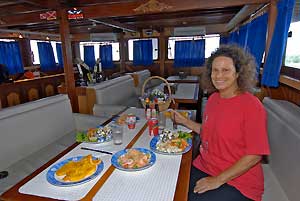 Camera battery charging stations
- Camera work stations
- Satelite telephone
- Sun deck with awning
- On dive platform shower
- Coltri Sub Compressor
- 14 gear up stations, 20 scuba tank
- European & Indonesian food
Vessel’s Technical Specifications
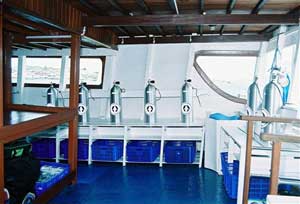 Type : Wooden Schooner
Length O.A : 33.52 meter
Beam : 7.50 meter
Draft : 2.10 meter
Main Engine : 300 hp
Speed : 8 - 9 knots
Electricity : 220 V
Tenders : 2 Capacity max 8 divers per tender
Safety : 2 life - rafts, 4 life buoys, 50 life jackets, 1 Cylinder of Emergency Oxygen, First Aid Kit
Navigation : Furuno Radar 1932 K , Furuno Depth Sounder, FCV - 612, Furuno GPS, HF SSB Radio
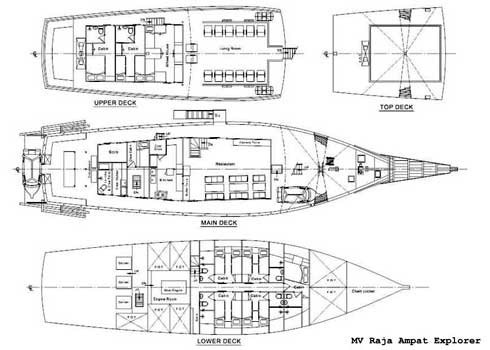
The Sea Safari 8
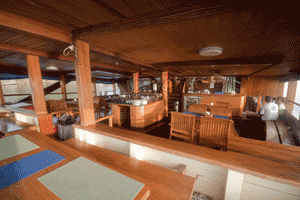 The KLM Sea Safari VIII is Indonesia's largest and most spacious luxury Phinisi liveaboard.
One of the very few dive vessels in Indonesia built according to international marine class specifications, Sea Safari VIII spans an impressive 54 metres long and 11 metres wide, providing guests with an abundance of space and luxury.
The Sea Safari VIII is dedicated vessel for all scheduled cruises in the Far East of the Indonesian Archipelago including the Raja Ampat archipelago.
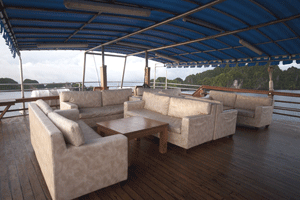 Indonesian 'Bugis Prahus', commonly known as Pinisi (pronounced "finisi"), are made from locally grown timber according to a tradition that dates back to long before Portuguese colonists reached the area. The classic beauty and elegance from the Sea Safari VII combines this traditional craftsmanship with modern conveniences, providing guests with luxurious comfort even in the remotest waters of the Indonesian archipelago. The Sea Safari VIII is Indonesia's ultimate luxury liveaboard scuba diving vessel.
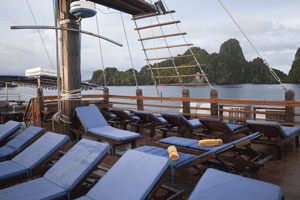 Vessel Specifications:
The vessel has been extensively customized and refitted to suit long range live aboard scuba diving expeditions and underwater photography. Constructed with three decks the Seasafari VIII gives you plenty of space to lose oneself; whether it is in the air-conditioned comfort of the large saloon or on the decks under the shade of one of the ship's huge sails.
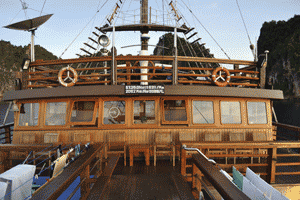 Type: Pinisi Schooner
Hull: Ulin Wood (Iron Wood)
Gross Tonnage: 295 GT
Cruising Speed: 7-8 Knots
Length: 54 Metres (177 Feet)
Beam: 11 Metres (36 Feet)
Draft: 4 Metres (13 Feet)
Fuel Capacity: 40 Tons
Main Engine: 435 hp Deutz
Generators: 1x25kw, 1x40kw, 2x60kw
Water Capacity: 60 Tons
Desalinator: 8 Tons/Day
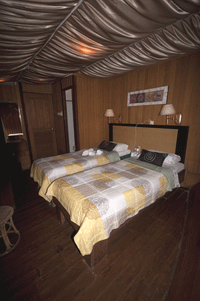 Safety Equipment:
•4 Units Inflatable Life Rafts
•110 Life Jackets
•12 Life Buoys
•Smoke Detectors
•Fire Hoses & Hydrants
•C02 & Powder Fire Extinguishers
Dive Support Equipment:
•3 x Bauer Air Compressors
•1 x Nitrox Blending Unit
•1 x Aluminum Dive Tender - 620 cm - 2 x 40 hp
•1 x Aluminium Dive Tender - 520 cm - 1 x 85 hp
Accommodation:
•3 x Below Deck Twin [Capacity: 2 pax/cabin]
•6 x Below Deck Single [Capacity: 1 pax/cabin]
•4 x Main Deck Stateroom [Capacity: 2 pax/cabin]
Navigation & Communication:
•1 x Faruno 1832 Chart Plotter with GPS
•1 x Faruno GPS
•1 x Faruno Radar
•1 x Faruno Echo Sounder
•1 x VHF + 1 x SSB Radios
•1 x Satellite Phone
Sea Safari 8 is available for charter for groups up to 23 persons max. Please ask for prices and special offers.
The Seahorse
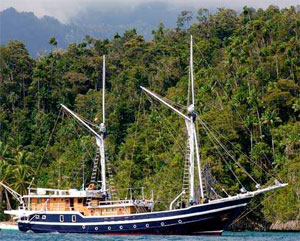 At 33 metres long and 8.5 metres wide, the MSY Seahorse is a majestic and spacious, traditional Sulawesi style “Phinisi” sailing boat, accommodating up to 16 guests and attended by 12 crew.
With a 380 hp MAN engine, the ship has a cruising speed of 9-12 knots to ensure swift travel.
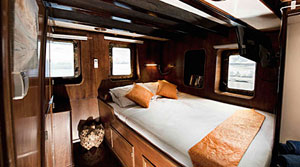 All of Seahorse’s cabins have individually controlled air-conditioning, private en-suite bathrooms with hot water and plenty of room for storage.
Cabins
The 6 standard double cabins are 12 square metres and have two single 90 X 200cm beds, the 2 Deluxe cabins are 13.5 sq. metres, have a 150 x 200 cm beds, desk, TV and dvd 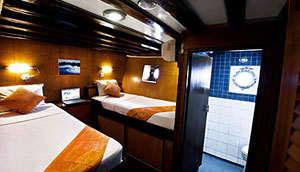 player.
The classic beauty of the MSY Seahorse combines traditional craftsmanship with fully modern conveniences and safety features, providing charming comfort in the remotest waters of Indonesia.
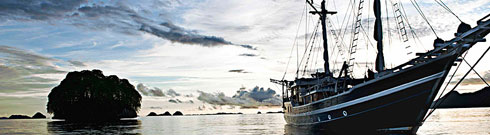
4 Dives per Day
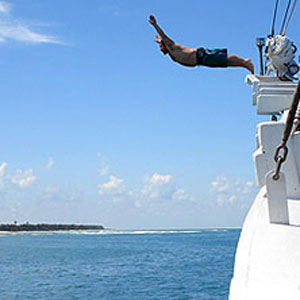 A typical day on board the Seahorse starts with a satisfying breakfast of fresh fruit juices, toast, coffee/tea, cereals and eggs any style to satisfy your morning hunger.
After the first dive, a full breakfast will be served on board, and in between eating and diving there will be spare time to relax on the sundeck, read a book, have a chat or check out the mornings digital photos on your laptop.
Lunch is served after the second dive and usually, a quick afternoon siesta.
 The food-dive-food routine follows after the third dive of the day, after which you can enjoy a lazy late-afternoon on Seahorse’s sundeck, lounging back and soaking in the wonderful landscape with a cup of coffee or tea and some snacks.
Dinner is prepared after the night dive, and the food is excellent. Hailing from a long tradition of big family home cooked meals in Spain, Seahorse’s owner takes pride in offering you a delicious menu elected from the best of Indonesian and European cuisine.
Technical Data
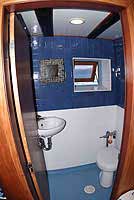 Length x Beam : 33m x 8.5m
- Engines : 380 hp MAN engne
- Max speed :
- Cruising speed : 8-12 knots
- Navigation equipment : EPIRB emergency locator, E.P.I.R.B., Furuno 90 NM radar, 2 x GPS w/plotter depth-sounder Furuno
- Communications equipment : Sat-phone, FM & SW Radio, 4 VHF and SSB Radio
- Fuel capacity/range : 20,000 litre
- Fresh water capacity : 11,000 liters fresh water storage, 6,000 l/day water maker
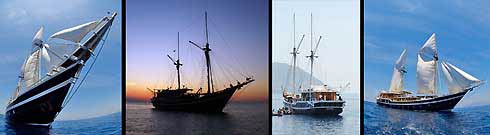
The Shakti
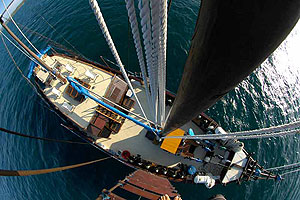 KLM Shakti is a traditional-style Pinisi sailing schooner able to cover large distances in a short time carrying up to 13 divers in Air-conditioned comfort. Her sleek lines and modern equipment mix with her traditional massive sail plan and rigging to offer the sensation of cruising West Papua's Raja Ampat Islands and the other eastern islands of Indonesia in a time honored fashion but in the maximum of comfort.
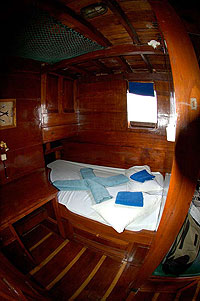 A/C cabins and reading/video room, a spacious and beautiful saloon and her large sundeck and dive deck mean that there's always somewhere comfortable to relax between dives and in the evenings.
SHAKTI was launched from the famous boat building beaches of southern Sulawesi where she was designed and built by her owner David Pagliari. She has been permanently based in Raja Ampat since 2002. During this time David and his team have extensively explored the area for new dive sites and can now offer diving itineraries to previously unknown locations.
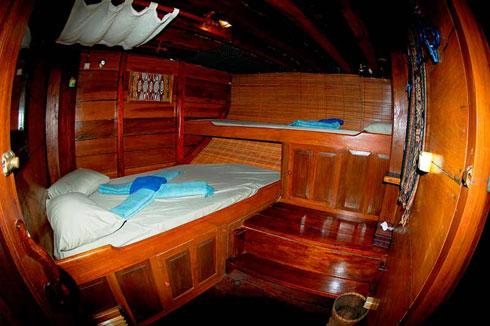
Crew
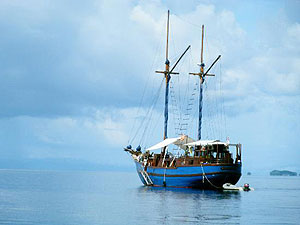 The Shakti crew is a team of 8 Indonesians most of whom work together since years.
David Pagliari, owner and skipper of the boat as well as cruise director is also managing the diving. He is looking back on 11 years of diving and exploring the Raja Ampat waters. His knowledge about the area, its culture, people, mystical stories, marine life is outstanding.
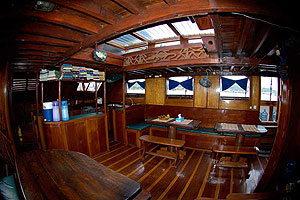 With a maximum number of 10 divers and 2 western Divemasters the groups are never bigger than 5.
The Shakti has been permanently based in Raja Ampat since 2002. During this time David and his team have extensively explored the area for new dive sites and can now offer diving itineraries to previously unknown locations.
Note - Shakti cruises require a minimum of 6 passenger to confirm departure. Individual bookings are confirmed through receipt of a 25% deposit. In the event that the required minimum six passengers have not been confirmed by six weeks prior to the departure date, Shakti's cruise director may decide to cancel the cruise, in which case the 25% deposit will be refunded in full including any bank charges that have been incurred.
- See more at: http://www.symbiosis-travel.com/indonesia/dive-liveaboards/110/dive-raja-ampat-with-shakti/#sthash.mzSyplm9.dpufCabins:
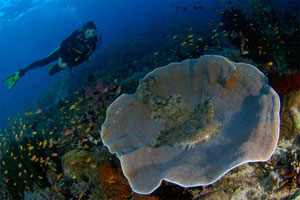 4 spacious cabins below deck with double and one single bed
- 2 single cabins above deck with one double bed
All cabins have ind. controlled air conditioning and electricity 24 hours a day
- 3 bathrooms with toilet, shower, sink
- 1 outdoor shower
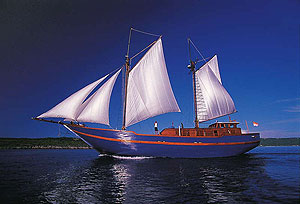 Facilities:
- spacious AV lounge below deck with a big white board and projector for home cinema, air conditioned
- individual charging stations
- 3 camera tables
Diving:
- 3x HP compressors (0cfm/9cfm/5.5cfm)
- NITROX membrane system (9cfm)
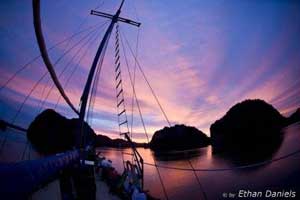 22 aluminium cylinders
- dive deck with individual dive stations - tank filling directly on the stations - the equipment stays connected for the duration of the cruise
- 3 day dives, one night dive (no diving on arrival and departure day)
Tenders: 2 alloy ribs with tank racks (1x 6.2m - x 4.5m)
Meals & Drinks:
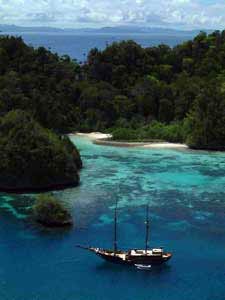 breakfast: continental with fresh fruit and fresh baked bread. you can order your individual breakfast egg style directly from the chef
- lunch and dinner - a mix of Western and Asian food with lots of fish, seafood, vegetables, chicken and beef.
- diverse snacks are served every day (fresh cake, cookies, nuts, etc.)
- always available: fresh fruit, coffee, tea, water, soft drinks, fruit juices
- Payment onboard: US$, EUR or IRD - no credit card payments
Adventure Trips
Not just beneath the sea, Raja Ampat offers a lot of interesting and fun other activities.
By arrangement, Symbiosis can offer adventure sailing cruises aboard the Shakti for you to explore Raja Ampat’s exceptional flora and fauna in its full spectrum, an unforgettable experience in an untouched and pristine natural environment. Amongst the attractions are world-class snorkeling spots, breathtaking anchorages, wonderful kayaking sites, bat caves to explore and much more.
Avoiding engine noise, Shakti’s comfortable sea kayaks allow you to spot parrots, kingfishers, sea eagles and many other bird species, and also juvenile sharks, turtles and rays in shallow turquoise water lagoons.
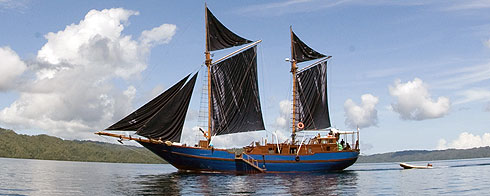
Electricity onboard:
24 hours a day
220V, US/European standard (2 pin)
Security:
- 2 capsule liferafts (24 person)
- 25 life jackets
- emergency oxygen facility
- first aid kits
Communications:
- Iridium Satellite Phone
- SSB radio
- several VHF radios
- radar, GPS, 2 sounders
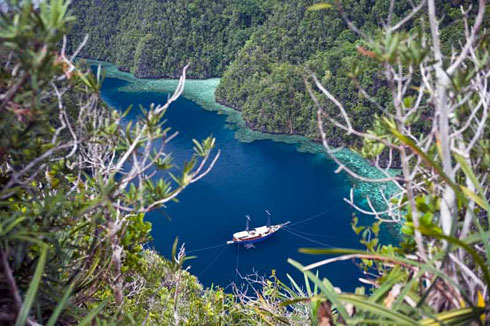
Boat Specifications
- Length: LOA32m, LOD 27m...
- Beam: 7m
- Speed: 9-11 knots
- Guests: 10
- Crew: 7 Indonesian crew members, 1 Indonesian dive guide, 2 European dive guides (Scottish and German)
The Tambora
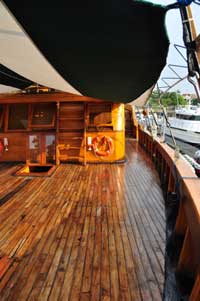 Tambora was built by traditional boat builders on the Indonesian island of Sulawesi, in the centuries-old tradition of a wooden Phinisi. The design and materials used guarantee immense strength and resilience of all key structural elements, especially the keel, hull and decks. Slight adjustments have been made to the original design, which was geared rather for cargo ships ferrying goods and commodities across the Indonesian archipelago, as compared to a modern liveaboard carrying passengers. Among others, they include a double keel and relatively smaller beam, to minimize rolling of the vessel in heavy seas.
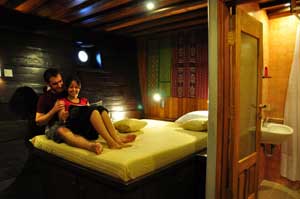 Tambora has been entirely constructed out of iron wood and chosen Javanese teak. While her hull has been painted white, the superstructure, decks and roofs have all been finished with a view towards preserving the natural beauty of the teak wood. All decks and the salon rooftop feature teak parquet flooring. This way, the rustic charm and warmth of a traditional wooden vessel has been preserved. All guest suites and rooms on board have been designed by a renowned Indonesian interior designer, and built-to-design by an experienced interior architect.
 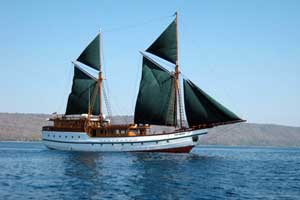 Guest suites are well appointed and tastefully designed in a perfect blend of traditional Indonesian motifs and modern functionality.
The traditional Phinsi-style arrangement of the sails has been kept unchanged. Experiencing Tambora under sails, with a good wind blowing, is an amazing sight and a great way to travel through the Indonesian islands.
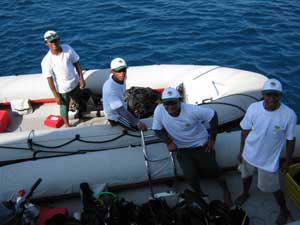 Great care has been taken to optimally combine the space and atmosphere on deck with the activities of liveaboard diving. Dinghies are equipped with customised racks to store diver’s gear in between dives; tanks do not need to be carried back and forth but can be re-filled directly on the dinghies. At night and during longer periods of sailing, all gear is stored away from the elements in the dive station. No dive gear is left sitting around on deck.
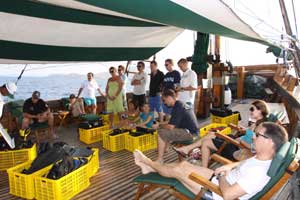 Spacious ...
Tambora has been sized and configured to comfortably accommodate a maximum of 16 divers:
- Eight spacious guest suites, each at least 15m2 in size, and with a large en-suite bathroom
- Choice of double and large twin beds (no bunk beds!)
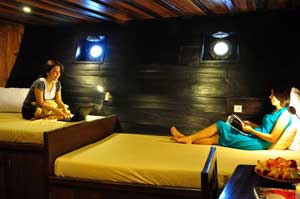 All beds longitudinally aligned with the vessel, so our guests sleep in the direction of the vessel movement
- Each guest suite comes with a writing desk. If you like, you can fill in your logbook or review the shots from the day’s diving in the privacy of your own suite
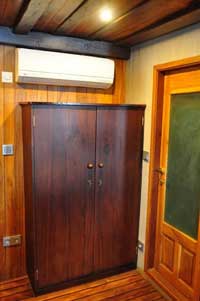 Ample storage space for clothes, bags, books, magazines, etc.
- Large salon with separate dining and relaxing sections, offering enough space during mealtimes, as well as for chilling out over a chat and drinks with fellow divers, with a book in your hands, or working on your laptop
- Three separate lounge decks – bow, aft and salon rooftop – provide enough space and privacy, and can be fully shielded from the sun
Well appointed ...
Guest suites and the large salon make life on board as easy as possible:
 Showers in all en-suite guest bathrooms come with individually adjustable hot and cold water
- Separate shower and hand towels for each guest
- Each guest suite comes with a writing desk. So if you like, you can fill in your logbook or review the shots from the day’s diving in the privacy of your own suite
- All guest suites are equipped with individually controllable air conditioning
- Individual reading lights above each bed
- Plenty of power outlets (European 220V type) in your suite and throughout the vessel
- 2-4 portholes per guest suite for natural light, as well as a fresh sea breeze when opened!
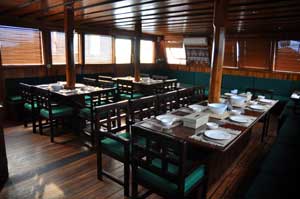 The large salon is well ventilated at most times, but also has its own air conditioning for those rainy days
- Large flat screen TV/DVD with home cinema surround sound in the salon
- Satellite-based communication for phone calls, your personal email and internet access
Quiet ...
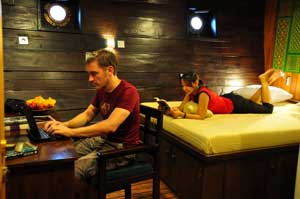 Noise – as such, or as a consequence of excessive vibration – can seriously spoil life on board. Noise has also been proved to contribute to fatigue and seasickness. Tambora has been designed and built to keep excessive noise under control:
- Throughout the entire vessel, separating walls have been soundproofed with noise absorbing materials. This helps mitigate noise, as well as guarantee the privacy of our guest suites
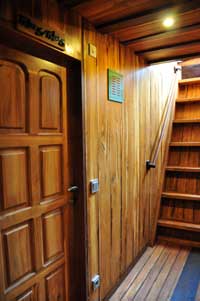 Engine room bulkheads are extra thick to absorb engine noise
- Similarly, all ceilings and decks have been soundproofed to mitigate step noise
- Tambora’s power train employs a flexible coupling to reduce vibration and thus structure-borne noise
- Her five-blade propeller is made of a special, very stiff alloy, minimizing internal vibration of the blades which are a key source of structural noise
- All engines under deck sit on flexible, shock-absorbing mountings
- Our “silent” water-cooled air conditioning system does not need noisy radiator fans
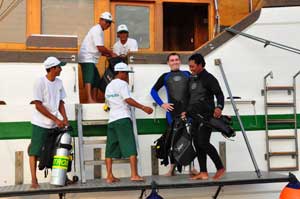 Cool ...
Among the natural luxuries of travelling at sea is enjoying the breezes when sitting out on deck. Conversely, inside a vessel, and especially under deck, temperatures can be too hot for comfort. Wherever possible, Tambora has been designed to mitigate this:
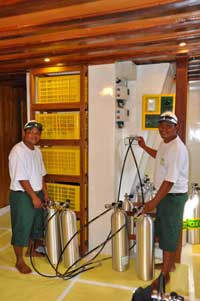 All ceilings and decks have been thermally insulated, to prevent the rooms underneath from heating up under the intense tropical sun
- Tambora’s hull is painted white to reflect sunlight. As trivial as it sounds, this makes a huge difference to temperatures inside!
- All guest suites as well as the large salon feature individually controllable air conditioning
Savory ...
- Tamboda's Chef serves a menu of tasty Indonesian, European and Japanese specialties, freshly prepared in the boat's well-equipped kitchen. Five meals a day mean there is a tasty bite awaiting you when you surface.
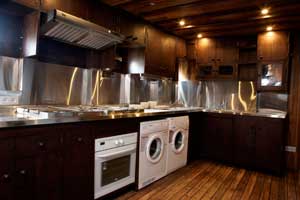 Snack prior to the first dive of the day: coffee, tea, fruit juice, milk, toast, selection of biscuits
- Breakfast after the first dive: choice of omelet, scrambled eggs, bacon and eggs, pancakes; also toast, marmalades, and fruits, served with coffee, tea, fruit juices, milk and soft drinks
- Lunch: served, soup and main course, kept rather light!
- Afternoon snack after the third dive of the day: variation of cakes, fruits, and Indonesian specialties, with coffee and tea
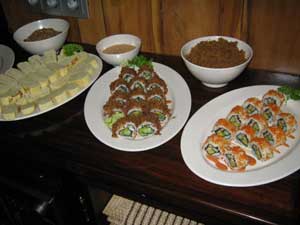 Dinner: buffet-style, with a different theme every evening
- Drinks are on a help-yourself basis available in the salon: drinking water, a broad selection of local coffees, tea, milk, a range of soft drinks soft drinks and beer are all included in the cruise fare
- Wine and liquor are charged on a separate basis
Lowest Possible Carbon Emissions
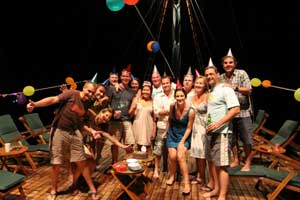 For the time being, there is no way to operate a ship like Tambora without burning fossil fuels – by the ships’ main engine, to thrust the ship forward when there is not enough wind, and by its auxiliary engines to generate the electric power required to illuminate rooms and cabins, keep food fresh, prepare meals, fill dive tanks, and many others. While the usage of diesel cannot (yet) be avoided, Tambora's crew go to length to keep it as low as possible. This means lower carbon emissions into the atmosphere. It also means no need for fuel surcharges.
Tambora’s propulsion system has been engineered for maximum fuel efficiency. At the heart is a new, genuine marine engine, which is significantly lower on fuel consumption. The five-blade propeller has been custom-designed and fabricated from a special, stiffer alloy, minimising power losses due to both internal vibration and unnecessary slip.
The electrical system, too, has been designed end-to-end with a view towards maximum fuel efficiency, including:
- A range of genuine marine and industrial power generators with different output, allowing us to always choose the most suitably sized engine under different load conditions
- Capacitor banks to smooth power needs and curb peaks
- Over-sized marine cabling throughout the entire vessel, resulting in lower distribution losses
- The exclusive usage of power saving lighting throughout the entire vessel; searching for a conventional light bulb is a futile exercise on Tambora!
- The thermal insulation of all decks and ceilings, and the usage of a white, reflecting paint on the outer hull above the waterline, avoids the vessel’s interior from heating up too much under direct sunlight, so that air conditioners do not need to run so hard to keep temperatures comfortable
The Temukira
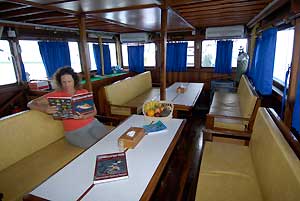 Owned by one of the original and most experienced liveaboard dive operaters in Indonesia, Temukira is a pinisi-shaped boutique live-aboard, manned by a friendly and competent, local crew. One of the only pinisis with a dive platform! Accommodation for 12 passengers is provided in 6 cabins: 2 doubles and 4 with twin bunks. All have individually controlled air conditioning and private
 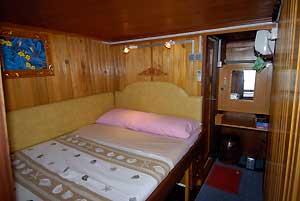 bathrooms. and many small but important facilities for living aboard on a long trip.
Boat Information
- Name : Temukira
- Destination : Indonesia
- Seasons : Year round
- Capacity : 12 non_drivers/12 divers. (max no. guests)
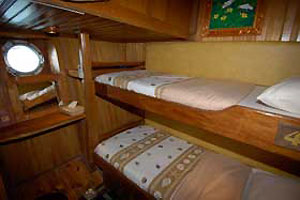 About the cabins
- Cabin Facilities Room : 2 double beds
- 4 twin sharing
- Ensuite +1 - showers & toilets
- Electricity :
- Sockets:
Technical Data
- Length x Beam : Loa 27.45m, beam 6.75m
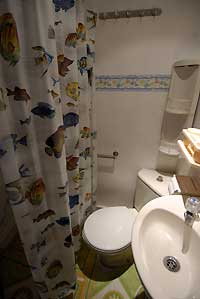
- Engines : Nissan RD 8. 280 HP
- Max speed :
- Cruising speed :
- Navigation equipment : HF SSB Radio,GPS, Radar, Depth Sounder
- Communications equipment : HF SSB Radio, Marine Satellite Telephone
- Fuel capacity/range : 4 tons
- Fresh water capacity : 12 tons
Further Information
- Dive Entry : Dinghy
- Life jackets : Yes
- Life rafts : Yes
- Boat Crew : Local Indonesian

